Hi, it’s been a while. I know I haven’t posted in a few weeks and I wanted to give you a small personal update and touch on a few of the things that have happened since my last post.
First, I should say that the reason for my absence is two-fold. I took on a new role at work starting in December, I was actually doing part of two jobs at once because they hadn’t backfilled my old role and there were some essential functions I did that only I knew how to do. The woman who recruited me to switch departments, and who was training me, suddenly turned in her notice in late January. So, for the last 3 weeks, I’ve been doing part of 3 jobs. I’m fortunate that people at my company have helped out, but there’s only so much they can do. Needless to say, I haven’t really had the energy to think, let alone write.
The second, more exciting reason, is that my wife and I bought a house, and I’ve been shopping for mortgages. We’re going to make a big announcement on social media next week, but we’re moving closer to our families and will be homeowners for the first time. It’s all very exciting, but as anyone who has ever bought a house can tell you, it’s also quite a lot of work.
The good news is, I see a light at the end of this tunnel. The mortgage stuff seems to be settled for now and we are flying down next week to look at our homesite (it’s a new construction project so we aren’t moving for a while). We finally hired my replacement and he started this week. I may end up getting a new manager sooner or later and I can focus on my actual job. However, I’ve learned that in the solar industry, nothing is constant and only fools predict the future. We call it the “solarcoaster” for a reason.
That being said, I’ve at least been paying attention. A lot has happened since my last post. Here are three climate things that really stood out to me.
The most obvious event is probably the war in Ukraine. While it isn’t the most important part of this conflict, we should keep in mind that EU reliance on Russian oil and gas is constraining its efforts to help Ukraine. In fact, without oil and gas revenues, Russia may not even be capable of the invasion. It’s just one more benefit to ditching fossil fuels. Nonetheless, we should also keep in mind that heating in the winter, especially in northern climates, is still a challenge for renewable energy. We need investments in things like green hydrogen and long duration energy storage to really break our reliance on natural gas.
The second thing that happened is the IPCC released the next part of its assessment. This is part 2 out of 3 and it was not exactly optimistic. We are not ready for the effects of climate, and the most vulnerable are also the least able to adapt. Poor, low-lying countries and communities, as well as arid places will bear the brunt of this. But, there was a glimmer of hope, if we radically reduce our emissions, we still have time to stave off a catastrophe. Though, even the authors admit that’s unlikely to happen.
There was also a report released by the US government regarding sea level rise. It said that US average sea level will rise by 10-12 inches in the next 30 years. That’s as much as the previous 100 years, representing a significant acceleration of sea level rise. I say “average” because it won’t be the same across the country, places like the Gulf Coast will see more (18-24 inches). It also predicted at least 1 more foot of rise between 2050 and 2100. That’s the best case scenario. The worst case is 7 total feet between now and 2100. Surprisingly, this actually represents an improvement. A few years ago, the worst case scenario was 8 feet. So, we are in fact moving the needle in the right direction, ever so slowly.
That’s all for now. I have no idea when I’ll get back to a regular schedule. It really depends on how everything plays out. I may move to a biweekly schedule or something like that, just to stay consistent.
Today I’m starting a series on several emerging “miracle” technologies, all of which have the potential to radically improve our chances of avoiding a climate crisis, but none of which are currently available at scale. The first technology I would like to explore is called Direct Air Capture (DAC) of CO2. The very first “climate Friday” Facebook post I ever wrote was about carbon sequestration. DAC is a subset of that group, along with “carbon capture” and ecological restoration. Technically, DAC is a subset of a subset of carbon sequestration called carbon removal.
I’ve written before that there are no silver bullets, and I stand by that. No single technology or policy alone will save us, it’s going to take a whole suite of political and technological advancements to get us over the finish line. That being said, there are several technologies with some pretty powerful potential. Any of the tech that I’m going to explore over the next few weeks, could make it much easier to reach our carbon goals. I have not yet finalized my list, but I will be exploring green hydrogen, nuclear fusion, and DAC.
As I’ve written before, carbon sequestration is an essential part of a carbon negative economy, which is what we need as soon as we can get it. There are a few options for this, the first is habitat restoration, which revitalizes natural carbon sinks like grasslands and forests, the second is something called carbon capture, which uses technologies at the end of smoke stacks to prevent the carbon from reaching the atmosphere. Carbon removal, including DAC is a third option that involves machines which pull the carbon directly from the air and stores it, ideally in some useful form like a brick or other material.
The first two approaches are further along. We’ve been altering habitats for thousands of years at this point. But, in order to have an impact on climate change, we have to increase the worldwide capacity of natural carbon sinks. This means that for every carbon sink we destroy, we must restore an even larger carbon sink in order to increase our natural sequestration. However, this has a limit, we obviously can’t restore every forest on Earth (we need land for farms and cities and other uses), and even if we did, this isn’t a permanent solution. You see, natural carbon sinks have a limit to how much they can sequester. Once a tree reaches mature age, for instance, it stops growing (or slows down) and once it stops growing, it basically stops sequestering carbon at a meaningful rate. The carbon is has stored in its trunk and roots remains as long as the tree is alive, but it only sequesters more carbon as it’s growing. So, while a mature forest has a lot of stored carbon, it isn’t really sequestering much anymore since it isn’t doing a lot of growing.
Carbon capture is another technology, one which is often touted by fossil fuel companies because it seems like we can have our cake and eat it too. If we can sequester carbon directly from power plants, then why can’t we keep burning fossil fuels? Well, these technologies don’t trap all of the carbon, or even most of it. Maybe we can improve them, but that would likely drive up the cost of fossil fuels, making them less competitive compared to renewables which have a falling cost curve. I think we all want to fight climate at the lowest cost possible. We should not intentionally make the energy transition more expensive than it needs to be. So, while carbon capture is useful at the moment, it probably won’t make sense in the coming decades.
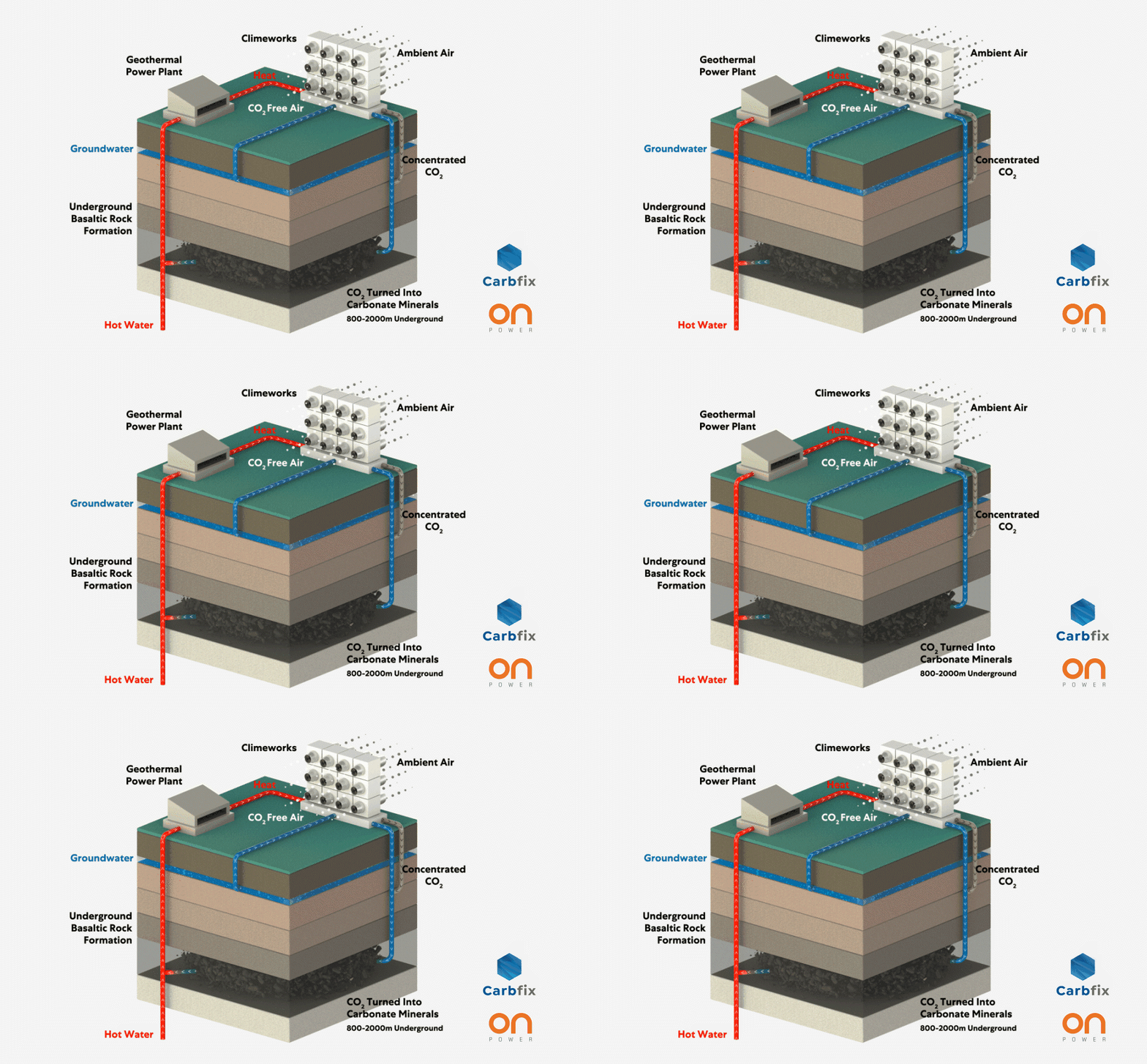
Direct Air Capture is something different entirely. The machines come in different forms, some look like a stack of box fans, others look a forest of petrified trees.
Artist’s rendering of the Arizona State University MechanicalTree Project.
They suck air in, remove the carbon, and then push the air out. They offer a tantalizing solution to a serious problem. After all, wouldn’t it be easier to just build a huge fleet of these instead of transitioning the whole economy over to new fuel sources? Maybe. But, time is not on our side.
You see, if it were 1950, we might have enough time to implement this solution at scale, but we have about 11 years left in our carbon budget, and scaling up an industry like this will take time. Over the course of a year, the entire DAC industry removes about 8 seconds worth of carbon emissions. Even if that doubles every year for 11 years, a blazing rate of growth, you’re talking about a few hours worth of emissions. Even if I’m off by an order of magnitude in terms of growth, it still isn’t going to be enough if we don’t reduce our emissions. And, if these machines give us a false sense of security we may end up increasing our fossil fuel use and erasing any gains made by DAC.
But, that doesn’t mean this isn’t worth doing. We don’t really need DAC to make a huge difference right now. Our primary focus should be on reducing emissions through electrification and renewable energy + nuclear power. DAC has about 30 years to grow to scale, because in the second half of this century, we will need to begin drawing carbon out of the atmosphere in enormous quantities. As I’ve written before, our goal is carbon neutrality by 2050 and then carbon negativity thereafter, until we reach a global CO2 PPM that scientists deem desirable (probably somewhere between 280 and 350 PPM).
It seems very unlikely that we will decarbonize every aspect of our economy over the next 30 years, so we will need some form of sequestration to fill in the gaps, and direct air capture is the only technology that promises perpetual carbon removal. Carbon capture will shrink as we phase out fossil fuels, and as long as the human population keeps growing, there will be a serious limit on how much ecosystem restoration we can do.
So, ideally, when 2050 rolls around, we will already have a fleet of these plants removing carbon cheaply and efficiently. That should be the focus of government policy in this area. We need public and private investment to improve the technology, to scale production, and to make it affordable.
In order to do this, we need either a price on carbon or a carbon tax, something that will create a market and demand for this service. Right now, the only reason anyone does it is because it’s good for the environment (and a company’s reputation), at least in the US. We need the government to either mandate that companies are carbon neutral, or for the government to tax the carbon in such a way that it’s more affordable to pay for direct air capture than to pay the tax. Without this, the industry simply won’t scale up. Companies and organizations will not voluntarily offset their emission in sufficient quantifies. We can use markets to make this happen, but we need the government to create the market in the first place. A so-called free market will do what it always does, pushes costs and pollution on to the general population wherever and whenever it can. But, a property designed carbon market, which an adequately high price on carbon, will likely be more efficient than a government mandate.
And remember, this is not an excuse to keep burning fossil fuels. This is not a miracle technology that will let us burn coal without consequences. We need both decarbonization and carbon removal. Direct Air Capture has the potential to be an extremely useful tool, and in fact it may be necessary at this point if we want to avoid a catastrophe, but it is not a replacement for clean energy. It is a complimentary technology.
As I’ve said before, the first and most important goal is to reduce and replace our reliance on fossil fuels wherever we can. Some industries, like heavy manufacturing, shipping, and commercial air travel will be very hard to decarbonize, and it may be necessary that we use some carbon removal to make them carbon neutral. But, in other areas like personal vehicles, building heat, electricity, and mass transit, we already have sufficient technologies to decarbonize these sectors. We do not need need to keep coal plants open, or internal combustion engines humming.
Fortunately, the Biden Administration is working to advance these technologies. The DOE announced in June of 2021 6 grants, 3 of which went to companies in my once and future home of North Carolina, that are working on carbon removal, including the mildly creepy project at Arizona State.
Ultimately, I feel quite optimistic about DAC. It is both a very clever and necessary invention. As with most climate issues, the fundamental challenges are time and politics, not resources or technology. With enough support, this industry can scale immensely and have a dramatic impact on our fight against climate change. But, without adequate support, it will remain a curiosity with lots of potential and little actual contribution.
As with all emerging climate technologies, DAC is not a miracle, it is the product of hard work and engineering, and it can’t solve the issue on its own. But, it can be an important tool in our toolbelt, something that can fill the gaps that renewables, alternative fuels, and other innovations can’t solve.
Hello, just a short post today. I’ve decided to take a break from writing posts. I feel like the quality has gone down and I wasn’t really aware of how much work this would be when I got started. I plan to work a bit on the layout, and put together a plan for new content for 2022. Tentative return date will be the first Friday in January.
To be honest, when I started this blog, I was reading about climate all the time, probably too much. It took a toll on my mental health because the headlines can be pretty bleak. I hope to come back with a new tone and a new plan for interesting, engaging, and informative posts.
Happy Holidays to everyone, I will be traveling to see family for Christmas, something I look forward to with great anticipation. Last year we obviously stayed home and it was simply not the same.
Much love to everyone who has ever read a post here and here’s wishing everyone a safe and happy holiday season.
Hello! I have a short post today. Hopefully I’ll be back with more in-depth content in the near future.
As part of the transition away from fossil fuels, we will see the growth a number of new kinds of energy production, including offshore wind. The US is pretty far behind other countries when it comes to this, but things are moving pretty quickly now. Every state from Maine to North Carolina is developing offshore wind projects.
Offshore wind has a lot of advantages but there are also challenges. Let’s start with the good.
First, offshore wind turbines are much larger than their onshore competitors. New offshore wind turbines being developed are 3x the height of the Statue of Liberty, and they produce 14-15 megawatts of power. One of these turbines could power over 1,000 homes. The height of the turbines is also beneficial because winds are more consistent higher in the atmosphere. New offshore wind turbines have a capacity factor of over 60% (compared with about 30% for onshore projects). This means they produce more electricity more consistently than other renewable sources (other than hydro electric). Offshore wind can also be sited relatively close to major population centers. Cities like Boston, New York, Philadelphia, and DC all have major space constraints, but there is plenty of room offshore. These farms are typically about 15 miles from the coastline. Given the diffuse nature of renewable energy, it’s unlikely that our big coastal cities can decarbonize without some significant offshore wind (unless they switched over to nuclear, which has its own challenges).
However, there are a lot of challenges. First, perhaps not surprisingly, offshore wind is more expensive than other renewables. Some of this is just normal, since it’s more difficult to build big infrastructure in the ocean than it is on land. But some of it is because America doesn’t have the experience or the supply chain. As the industry grows in this country, costs will come down. In addition to the turbines themselves, we need oceanic transmission infrastructure (i.e. power lines under the water) to connect the farms with the users on land. These facilities are going to produce a lot of electricity so we’ll need pretty robust transmission infrastructure which doesn’t exist at the moment.
There are also some ecological concerns related to fish and wildlife, as well as concerns from commercial fisherman and coastal landowners. These issues can be resolved, but they should not be ignored.
Right now, most of the best area for offshore wind is on the east coast, because there is more available continental shelf. Offshore wind turbines are currently attached to the ocean floor. But, floating wind turbines will open up the west coast for development there as well.
The advances in this area are pretty exciting, but the costs, siting, and occasional opposition threaten this nascent industry. Some coastal communities that relied on fishing may be revitalized as this industry grows. Here in Massachusetts, the town of New Bedford is the focal point for the new offshore wind infrastructure, and other towns in other states are doing the same thing.
It probably doesn’t surprise you to learn that I’m a huge fan of Sir David Attenborough. I’ve watched every documentary I could find that he’s involved with. From groundbreaking work like Planet Earth and Blue Planet to more recent Netflix collaborations like David Attenborough a Life on Our Planet and Our PlanetI feel like he has been a constant companion in my home, and one of the best teachers I’ve ever had.
So of course I was excited to watch Breaking Boundaries which debuted in 2021. I was fascinated by the message he had to give, and so I jumped at the chance to read the book that accompanied this film. Breaking Boundaries: The Science of our Planetwas written by Johan Rockstrom and Own Gaffney, two scientists from the Stockholm Resilience Centre. It expands on a paper they originally published in 2009.
The central argument of the book is that our civilization is safe guarded by 9 planetary boundaries: climate, ozone, biosphere, novel entities (plastics and other trash), aerosols, ocean acidification, biochemical flows (nutrient pollution), freshwater, and land system change (habitat destruction). The authors use expensive research to support the idea that we have entered a new geological epoch, the Anthropocene. They argue that the Holocene Epoch, which started approximately 11,000 years ago, ended in the 1950s and our current epoch began. The evidence they present is damning and convincing. They use the 9 planetary boundaries to illustrate how humanity’s impact has exploded in the past 70 years and that we are now the primary force of change on the planet.
What’s essential to understand is that each of these systems has an outer boundary of what is desirable for human habitation. For some, such as novel entities, we ideally wouldn’t have any. But, for most of them, there is an acceptable amount of degradation we can commit while maintaining the planet’s livability for human civilization. Of the 9 categories, and two subcategories, we are into the danger zone for at least two of them, biochemical flows and biosphere integrity. For the moment, climate and land system change remain in the “caution” zone, though both are steadily approaching the danger zone.
Of the nine boundaries, only ozone depletion is moving in the right direction. That’s because it was the first of the problems that global policymakers took seriously when they passed the Montreal Protocol in 1987. In about 30 years, the ozone layer should be completely restored.
Once these systems are moving the wrong direction, it takes a long time to turn them around, and even longer to repair the damage. Breaking Boundaries puts a lot of emphasis on feedback loops and tipping points. To understand why this is critical, let’s do a quick dive into each of these concepts. (If you know what the are already, feel free to skip the next two paragraphs).
Feedback loop: This is a system that is self-reinforcing. Sometimes called a vicious or virtuous cycle, it is a key concept in systems thinking. We’ve all experienced this in some way or another and it’s pretty simple to understand. If you’re stressed out, it’s hard to sleep, and if you’re sleep deprived, it stresses you out even further. The longer the cycle continues, the more stressed and sleep deprived you become. One reinforces the other until something breaks the system (either you get help or have a nervous breakdown).
Tipping point: This is a point at which a process suddenly accelerates and becomes much more difficult or even impossible to reverse. Often there is a lot of time and energy put into a process with little results, until something tips and then things accelerate. Literally pushing a boulder up a hill until you reach the top and then letting it roll down the other side is an actual tipping point. Once it starts rolling, you have little chance of stopping it before it smashes into something.
Climate changeis greatly affected by both tipping points and feedback loops. Here are just a few examples.
The Greenland Ice Sheet was formed over thousands of years, mostly during the last Ice Age, when global average temperatures were much lower. As the planet warms, the ice sheet melts. The ice sheet is about 2 miles thick, and the ice at the top thaws and refreezes each year. However, as the ice sheet thaws, it does not completely refreeze. Some of the ice is permanently lost. As the ice sheet gets shorter, it enters warmer air (since higher altitudes are colder). The shorter the ice sheet gets, the more it melts, and the more it melts, the shorter it gets. Eventually, we hit a point where the ice loss is irreversible and there’s nothing we can do to stop it, only to slow it down. If the ice sheet melted completely, it would raise global sea levels by about 6 feet. It’s possible that we have already passed this tipping pointand the only question is how fast it melts.
Albedo is an effect in which light colors reflect sunlight and dark colors absorb it. We’ve all experienced this. When I was a kid we went to a public pool. Like many kids, I couldn’t be bothered with shoes at the pool, so I just went barefooted. In the parking lot there was blacktop and white lines marking the parking spaces. I would walk across the white lines and sprint across the blacktop, since it was scalding hot. I’m sure we’ve all done things like this. This process is hugely important for thermal regulation of our planet. In the northern latitudes, there is perpetual snow and ice. That snow is obviously light colored, and it reflects heat back into space. As the snow melts, it reveals darker colored ground beneath it. Rather than reflecting heat, these darker surfaces absorb the heat, causing the planet to heat more. This increased heating then accelerates the melting of ice, which accelerates the loss of albedo. As with the Greenland Ice Sheet, we may already have passed this tipping point, as more of the Arctic becomes ice free during the summer.
Frozen in the world’s permafrost is a massive amount of methane. Methane, while shorter lived in the atmosphere, is much more potent than CO2 at trapping heat. As this permafrost melts, it releases this methane, which then traps more heat, thus melting more permafrost. The melting of permafrost will continue long after our economy stops emitting greenhouse gases, the planet is simply too warm to hold onto it. Thus, we’ve likely passed the tipping point for permafrost melting.
Each of these examples illustrates that getting to a carbon neutral economy is really the second step of a long process (the first is capping our annual emissions and then reducing them year over year). We will then need to become carbon negative (which means drawing more carbon out of the atmosphere than we emit), and we will need to restore ecosystems around the world (some, like coral reefs, we may need to bring back from extinction), we’ll also need to adapt our civilization to a new reality, and prevent this from happening again. Ice sheets will continue to melt long after we hit carbon neutrality, and sea levels will keep rising for at least a few centuries.
Breaking Boundaries is not an uplifting book. You can feel the desperation of these scientists who have been screaming into the void for over a decade. However, it is succinct, easy to understand, and very clear about our situation. It presents the 9 life support systems in a way that anyone can understand, and it expertly shows how they are interrelated, and how action to address one can often help address the others. They are ambiguous about our need for systemic change as soon as possible, and they illustrate just exactly what our lives would be like if we blow past 2 degrees C warming.
In reality, these systems are actually quite fragile, and we humans have done our best to wreck them. Anyone who thinks we are too insignificant to change the entire climate should remember that 2.5 billion years ago, a tiny ocean life form called cyanobacteria (blue-green algae) managed to alter the Earth’s atmosphere and cause a catastrophic mass extinction. Humans are the first species since then to have this big of an impact. The Earth survived the Great Oxidation Event and it will survive us.



 The Mangrove