Emerging Technologies Part 2 – Nuclear Fusion

If you get news alerts for climate or energy, you may have seen a flurry of recent announcements regarding nuclear fusion. Scientists in Europe and North America have made breakthroughs in recent weeks, using different techniques, in the quest for a stable, energy positive nuclear fusion reactor. These developments are tantalizing and exciting, but we should also keep things in perspective. Let’s be clear, commercial nuclear fusion reactors are still years away and given the time constraints, they may not have a serious impact on our climate goals. So, while these developments around fusion are unambiguously positive achievements, we should not count on fusion to save us.

As I’ve said before, we must focus on reducing emissions now. The danger with fusion is that we drag our feet on emissions reduction because we think this miracle tech is going to solve our problems, like some modern “deus ex machina.” That’s a recipe for disaster. At the same time, we should all want nuclear fusion to work. It’s truly a revolutionary innovation with the potential to address a number of problems, including climate change. So, my point is not to disparage these recent developments, I think we should be celebrating them, but the hype machine is running at full capacity and we’re in danger of losing our perspective.

First, let’s start with some basics. There are two kinds of nuclear energy production: fission and fusion. Fission involves splitting a heavy atom like uranium, which releases a large amount of energy. Fusion involves smashing together two light atoms, typically two hydrogen atoms, to form a heavier atom, in this case helium. Every nuclear plant on Earth uses fission, however, fusion is the thing that powers the Sun (and every other star as far as I know).

I’ve written before that nuclear fission is a perfectly viable zero-carbon power source and has some advantages over other power sources. But, it also has a number of challenges, namely perceived safety risk, price, and radioactive waste.
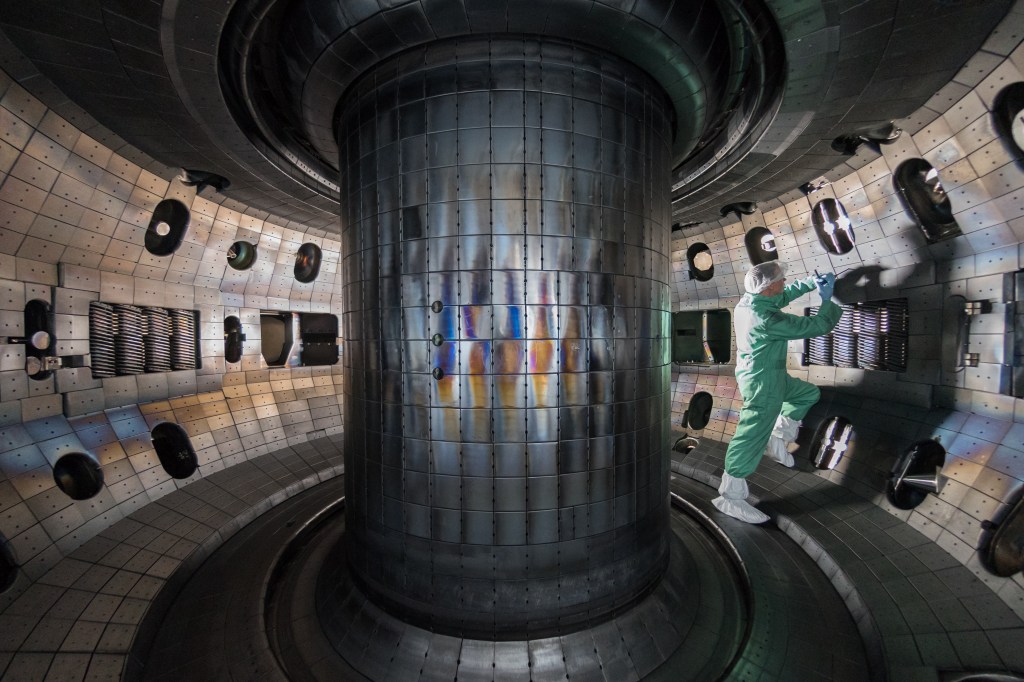
Interior of a Tokamak Fusion Reactor
By Rswilcox – Own work, CC BY-SA 4.0, https://commons.wikimedia.org/w/index.php?curid=73919081

Fusion is one of those technologies that seems more appropriate for Star Trek than serious policy discussions. It seems too futuristic, too science fiction-y. But, it’s a very real technology with some pretty amazing potential. Part of the reason it seems too futuristic is because it always seems to be just over the horizon. Scientists have been working on a fusion reactor for decades, with relatively little progress for us outsiders to see. There’s a tired joke among energy nerds that “fusion is always 30 years away” because scientists seem to have been saying that for decades.

As an outsider who does not work in the industry and cannot appreciate the magnitude of recent technologic advancements, fusion still feels like it’s decades away. That’s an important caveat when reading my analysis, I am not qualified to assess the veracity of claims made about the technology, I can only go on what the experts say. My questions about fusion relate to things like timeframes and costs, rather than technological feasibility. By all indications, we’re marching steadily towards a working fusion reactor sometime in my lifetime. And that’s exciting!

Now, when people talk about fusion, they often use hyperbole. They will say things like “fusion can create near limitless power” which is silly. I think they say this because the fuel comes from sea water, and water is obviously quite abundant. The promise of fusion is that we will be able to get an enormous amount of energy from just a small amount of water. Further, not only is our planet covered in water, but Mars, Europa, and Enceladus all have abundant water reserves. So, we’d be set on fuel for many centuries. But, fuel is not the only limiting factor. We will need to build a fleet of these reactors, and as of right now, we don’t even know what materials we need to do that. Until we know exactly what we need to build these things, we should not assume that the materials will be cheap and abundant.

Assuming, though, that the materials are easy to obtain, we still have unanswered questions. The plants themselves would have a maximum capacity, so the question is, how much energy would a typical fusion plant produce? I have yet to see a good answer for this. The ITER project in southern France is the largest nuclear fusion reactor in human history. It’s been under construction since 2007, costs tens of billions of dollars, and when it finally comes online (supposedly in 2025), it will produce 500 Megawatts of power. That’s not a small amount of power, but it’s still less than a typical fission reactor. ITER is obviously an experimental station, and not meant to compete with commercial energy generation, but with all that money and material, we’re still talking about a fairly small amount of power generation. So the question remains, how much power will we get out of these reactors? That will tell us how many we need to build.

The next question is cost. Of course, as with any new technology, the cost of the initial projects will be astronomical. But, what is the expected cost per watt in say 2040? As an energy nerd, I know predicting energy prices 18 years out is a fool’s errand, but we should at least be reasonably confident that costs will be competitive in an acceptable timeframe. Remember that solar, wind, and energy storage systems are all getting cheaper every year and that’s likely to continue. Eventually fusion will need to compete with them on cost, but it will undoubtedly need a lot of government support to get there. Personally, I have no problem subsidizing fusion since it has enormous upsides. Without government support, the fusion sector would probably wither and die.

Perhaps most important is the timeframe for these things. This is pretty hazy right now. First we need to have a working fusion reactor, which is something we’ve been working on for decades and still don’t have. If it takes a few more decades, then it will be too late for fusion to impact our climate fight. But even if we get a working fusion reactor say in the next 5 years, it would still be decades before fusion reactors were producing power at scale.

Unfortunately, time is not on our side when it comes to climate. Ideally, the electricity sector will be mostly decarbonized by 2035. Fusion may or may not be available at by then, but it almost certainly won’t be at scale in 10 years (if it is, I’ll gladly eat my words since that would be an amazing achievement for our civilization). We need to be focusing on the solutions we have right now, while supporting fusion and other advanced energy technologies. Solar panels use rare Earth minerals and there may be an upper limit to how many we can really install. We never want to put all our faith in a single technology. This isn’t an either/or situation, we can support advanced energy technologies and implement our existing solutions.

So, let’s celebrate the wins on fusion, keep the research money coming and encourage these achievements, but we should not count on a technology that does not yet exist. Until we have a working commercial fusion reactor, we should not rely on it as one of our solutions. A tool isn’t a tool if it’s still being designed. Or, as we say, don’t count your chickens until they hatch.

If you take anything away from this post, it should be this, advanced energy technologies like nuclear fusion are fantastic ideas that are worth our support and we should celebrate their development. However, no single technology will save us, we are in a race against time, greed, and indifference and we’re losing. We must accelerate our existing solutions, we must cap our emissions as soon as possible and begin the long, laborious, and complex process of decarbonizing our civilization. We do not need new technologies to do this, and we should not wait for some innovation to swoop in and save us at the last minute.

Assuming we don’t see any developments on the BBB front, I will next explore green hydrogen and genetic engineering as climate solutions. Have a wonderful weekend and stay safe!

The top things YOU can do about climate change

There is an excellent book and website called Project Drawdown which estimates the carbon impact of a whole range of activities. The purpose of the project is to find the most important actions we can take collectively to reduce the global carbon footprint. It’s a great resource for anyone who wants to see a simple ranking of the most important climate actions and an excellent starting point for anyone interested in doing something about climate change.

There are two scenarios on the website, Scenario 1 corresponds to 2 degrees C of warming by 2100, and Scenario 2 corresponds to 1.5 degrees C. Because I think it’s more realistic, I’m going to use the rankings in Scenario 1.

Of the top ten solutions listed, several of them are largely out of our control, but there are ways we can contribute to most of them.

Here they are, the ten most impactful actions we can take to combat climate change.

10. Distributed Solar PV – Literally what I do in my day job. This is industry jargon for “putting solar panels on your property.” Not everyone owns property, but there is something called community solar which allows people to buy into solar arrays even if they don’t have a good site or live in an apartment. For many people investing in solar can be both a financial and an environmental boon. Total impact: 27.98 gigatons of CO2.

9. Improved Clean Cookstoves – For those of us in the developed world, this may not be obvious, but hundreds of millions of people (mostly women and girls) use wood or other biomass like cow poop to cook their food. This has an enormous public health and climate impact. In fact, indoor air pollution from dirty stoves is one of the largest public health problems among the world’s poorest people. And we can all have an impact by donating to organizations like the Clean Cooking Alliance. Better cookstoves are a win for public health, for education (girls often gather fuel instead of going to school), for women’s equality, AND for the climate. Total impact: 31.34 gigatons of CO2.

8. Utility Scale Solar Photovoltaics – This is just jargon for big solar farms. The most important thing you can do here is get political. Vote for politicians to implement pro-solar policies. These kinds of decisions are made by legislatures and utility commissions. The policies around them are a bit complex, but organizations like SEIA and Vote Solar have voter guides that typically cover every state and federal election. If you’re outside the USA, then there is likely a solar industry association of some type in your home country that does the same. Also, I happen to work in the solar industry so feel free to reach out if you ever have questions. Total impact: 42.32 gigatons of CO2.

7. Alternative Refrigerants – This is another area where public policy is key. We need companies and government working in tandem to develop new refrigerants at scale and to phase out old ones like fluorinated gases. Unfortunately, I’m skeptical this will ever get much attention during an election and it’s unlikely to be at the top of anyone’s mind. Total impact: 43.53 gigatons of CO2

6. Onshore Wind Turbines – Wind energy is a mature industry here in the USA. Many states, particularly those in the middle of the country like Iowa and Texas, are already getting a large share of their power from wind. If left to its own devices, the wind industry would continue to grow over time, but in order for it to grow fast enough to hit our climate goals, we need robust public policy. The biggest danger here is politicians getting in the way or lying about wind energy, like many Republicans did after the Texas deep freeze of 2021. Total impact: 47.21 gigatons of CO2.

5. Tropical Forest Restoration – I assume that few of my readers currently live in the tropics. We all know that deforestation in places like Indonesia, the Democratic Republic of the Congo, and Brazil is a serious issue. These are also some of the poorest places on Earth, and the Tropics are in danger of getting too hot for human habitation over the next century. So, restoration of tropical forests has the potential for numerous positive impacts. The best way we can help is by giving money to organizations that fight against deforestation and empower local communities. Unfortunately, violence against environmental activists in these countries is not uncommon, and many people have been killed in recent years when they try to protect these forests. We should not turn a blind eye to this, not just for the climate, but for basic human decency. Total impact: 54.45 gigatons of CO2.

4. Refrigerant Management – Fortunately, this one is already moving in the right direction. In 2016, 170 countries met in Kigali, Rwanda to amend the Montreal Protocol, one of the most successful international treaties of all time. Countries will phase out the use of CFCs and HFCs over the next decade or so (which richer countries starting first and poorer countries going later). Total impact: 57.75 gigatons of CO2.

3. Plant-Rich Diets – This includes vegan and vegetarian diets, but it also includes diets that have meat but in lower amounts. Americans and other rich people eat a lot more meat and dairy than most sedentary people in human history. By simply reducing the meat and dairy portion sizes, or eating vegetarian for several days a week, we can have a huge impact on public health and the climate. Total impact: 65.01 gigatons of CO2.

2. Health and Education for Girls – This is another area where we can have a lot of positive impacts, not just for the climate. The goal here is 12-13 years of school for every child on the planet, and access to high quality birth control for everyone. This policy will have by far the biggest impact on women and girls, who make up the majority of the human species and yet are denied access to healthcare and education across the planet. Gender equality is a moral imperative in its own right, we don’t need other justifications. However, nearly every social and environmental issue, including climate change, is exacerbated by gender inequality. The positive impacts from gender equality are honestly too numerous for me to list. There are a large number of organizations in this space, such as the Malala Fund. Total climate impact: 85.42 gigatons of CO2.

  1. Reduced food waste – In some ways this is the easiest thing for us to impact. We all waste food, especially in the United States, and we can all do a better job here. But food waste is not just about us forgetting something in the back of the fridge, it’s also about public policies that lead to crops rotting in the fields, and cultural practices that lead to edible food being discarded for its appearance. Food waste is a pretty complex topic, and it might make sense to start with a book like Waste: Uncovering the Global Food Scandal. Total impact: 90.70 gigatons.

Some of these solutions may be surprising, since we tend to think of climate change solely through the lens of burning fossil fuels. But these solutions undermine just how simple, and complex, this problem is to address. I strongly recommend Project Drawdown to anyone who is interested in the full list. There are 82 solutions listed on the website. The book has a summary of each solution and it’s quite easy to understand. Rather than focusing on the negatives, there is a very solutions-oriented approach that presents climate as a complex but solvable issue.

That’s all for this week, stay warm and have a great weekend!

Welcome Back!

I hope all of you had a wonderful holiday season, even if you don’t celebrate any late December holidays. I enjoyed some much needed time with family away from my normal routines. I want to express my deepest gratitude to anyone who reads this blog and I hope we can grow that readership in 2022.

2021 was certainly a pretty intense year, and not just for the climate. Joe Biden took over as president with the promise of taking serious climate action, but right now we’re still waiting. The weather was predictably chaotic. We had numerous reminders that the climate is destabilizing at an alarming rate. Events like the deep freeze in Texas and the heat waves in the northwest showed us what happens when abnormal weather collides with outdated infrastructure.

We also received several new scientific reports, including the 6th IPCC assessment on the state of the climate. The Secretary-General of the UN referred to the report as a “red alert” for our civilization. We learned that the ocean’s currents may be in danger of collapse, and the Greenland Ice Sheet may already be doomed. COP26 came and went without any big revelations. Right at the end of the year, we learned that something nicknamed the “doomsday glacier” may collapse within 5 years. We also got an excellent climate comedy to entertain and possibly frighten us a little on Christmas Eve.

We saw some good news as well. The arrival of the electric pickup truck in America was a smashing success. Renewable energy had a banner year. We saw advances in carbon-free steel and cement, as well as a plethora of new meat alternatives. The private sector is racing ahead on climate solutions, even as the federal government drags its feet.

Over the break I’ve been thinking about what’s next for the blog. If BBB is passed, then we’ll talk about it, but if it doesn’t then we’ll move on. I’m already sick of the process. That being said, there is still a lot of action happening on the climate front. I will begin the year by breaking down the most important actions we can take as individuals, and the most important solutions we need to implement as a society. These will be based on numerous reports and books, especially Drawdown by Paul Hawken.

While I will be covering any major scientific updates and climate events, I will do my best to stay positive and relevant. I would be lying if I said I felt optimistic about the future, and that’s obviously going to show in my posts. But, I hope to provide solutions-based posts that can help you prepare for the future.

We should remember that there is no point of no return. Things can always get worse and there is always a benefit to taking action. We want to avoid 1.5 degrees C, that seems pretty unlikely at this point. Maybe we can stop at 2 degrees, maybe we can’t. But 2.5 is better than 3, and 3 is better than 3.5. As a species we are extremely adaptable. Cooperation and adaptability are the things that made us the dominant force on this planet, and those attributes will be essential if we’re going to flourish in this changing world.

Another theme I’d like to explore this year is a bit more abstract, involving geologic time. I believe we have entered a new geologic epoch called the Anthropocene. While still unofficial at this point, I think the evidence is pretty strong. Granted I’m in no way qualified to make a scientific assessment. However, between altering the climate and causing the 6th mass extinction in Earth’s history, there’s little doubt that humans have driven nearly all the major changes on this planet over the last 200 years.

There isn’t a square inch of this world, from the depths of the Mariana Trench to the top of Mount Everest that hasn’t been impacted by humans. We now have the power to completely destroy our home or to build a durable, sustainable civilization. We are going through something I call the Great Bottleneck and how we make it through may determine the future of our species for the next few centuries or perhaps even longer.

If I have one purpose with this blog, it’s to do something, no matter how small, to bring us closer to sustainability. The future I envision is something like the Star Trek universe. I know I’ll never see it, but hopefully, if we work together, we can set the foundation for our descendants to build a world based on science, morals, and equity.

So, here’s to a happy, prosperous 2022. I’ve made a few personal resolutions, like learning to play the keyboard, becoming fluent in Italian (something I started early last year as a COVID project), and quite possibly buying a house. I’m sure we’re all hoping 2022 is a bit less chaotic and stressful than the last 2 years.

In the environmental movement there tends to be a lot of hyperbole. Everything seems like a catastrophe and I think we all have a tendency to tune it out. If everything is terrible, then terrible is normal. But, truthfully, the next 8 years are critical. Ideally we would hit carbon neutrality by 2050. There is a specific amount of carbon we can burn and still stay under 1.5 degrees C (called our Carbon Budget). We’re currently on pace to spend our carbon budget by 2030, and our spending is increasing. Without major changes in the next 8 years, we simply won’t hit our targets and 2 degrees becomes a best case scenario.

Next week I will reveal my initial climate reading list for 2022. If there’s a good (or bad) climate book you’ve read, I’m always interested in recommendations.

Thanks again. Here is hoping that 2022 is the year we put COVID-19 in the rearview mirror, and we finally get some serious climate legislation.

No Silver Bullets

When we read about efforts to combat climate change, we often hear certain technologies praised as the only viable solution to the problem. This refrain is often heard when people talk about nuclear power, either “small, modular nuclear fission” or nuclear fusion. I’ve also heard it with reference to sustainable airline fuels, hydrogen, lab grown meat, and carbon capture and storage. There are people who insist that a 100% renewables grid is the only way to go, and others who call this a pipe dream. It can be pretty maddening at times. The reality is that no single technology is going to save us.

In fact, technology really isn’t even the main issue. A system that allows gross overconsumption of resources, particularly by a tiny percentage of extremely wealthy people, is never going to be sustainable. There is no magic technology that’s going to allow us to continue consuming at our current levels indefinitely.

The reality is, we need to change our consumption behaviors, and invest in research and development. We need to implement the solutions we have now, while developing new ones. We must focus on systemic changes and work within the systems that already exist.

This idea of a silver bullet reminds me of the Ancient Greek dramatic concept of “deus ex machina” in which a god of some type swoops down at the last minute to save the protagonists. It’s comforting to think that really smart people are inventing something that will save us all. We like to believe that our current personal behaviors are not the problem, and that we can pretty much go on living as we’ve always gone and everything will be fine. This is a fantasy.

Unfortunately, behavior change is unlikely to come voluntarily. Either through government coercion or, maybe worse, natural disasters and resource shortages, we will be forced to change the way we live. The sooner we understand this, the better it will be for everyone.

When we look at the conversation around climate change, a lot of people like to push these magic technology fixes. It’s not surprising, since most of them are personally invested in the fossil fuel economy. Someone like Joe Manchin who personally makes over $300,000 a year from fossil fuel investments is not going to give that money up without a fight. He continues to push this idea that we can innovate our way out of the crisis and continue to burn fossil fuels. Noted crank Bjorn Lomborg made the same argument in his book Cool It. These guys think that we can innovate our way out of anything.

Maybe they’re right. But if they’re wrong, we’re all screwed. You can think of it like a Pascal’s Wager for the climate. The only logical way to move forward is to assume there are no magic fixes. No nuclear fusion, no economic carbon capture, no zero carbon jet fuel, or any other too good to be true innovation that will solve the crisis. We don’t want to be in a situation were our technological salvation doesn’t come. At the same time, we should continue to invest in R&D for climate tech. Zero carbon jet fuel, Carbon Capture and Storage, Nuclear fusion, these are all great things and if they existed at scale, they would be extremely helpful. The point of this post isn’t to denigrate innovation, the point is that we can’t rely on solutions that don’t exist yet.

Realism vs Doomerism

I recently read an interesting post by climate scientist Hannah Ritchie titled Stop Telling Kids They’ll Die From Climate Change. She doesn’t use the term, but in it Ritchie scolds the “doomers” out there who she feels are deceiving the youth and actually hurting their own cause. Overall, I think I agree with her message. She cites a few extreme examples of people really exaggerating the likely outcomes, at least from a scientific view. She makes a number of excellent points about the dangers of exaggeration, and about the problem of doomsaying. She acknowledges that that things aren’t happening fast enough, and she empathizes with people who feel hopeless.

Her viewpoint is one of a scientist, and I certainly won’t question her understanding of climate science. That being said, as with most scientists, she really swings and misses on the social and political implications of the climate crisis. Granted, that isn’t the primary focus of the piece so it would be unfair to read too much into it. Perhaps she’s an astute political observer and it just doesn’t come across. My point is not to criticize what she wrote, just the opposite. The article is thoughtful, information, and definitely worth a read. It got me thinking about my own outlook and the tone that I set on this page.

As someone whose knowledge and interest are more firmly in the political rather than scientific realm, I know I lean closer to the “doomer” point of view. I often feel a bit despondent at our chances of success. One of my main concerns is the potential for climate change to destabilize political regimes across the world. Historically, in times of crisis, people have frequently turned to authoritarian regimes, and we’re already seeing the emergence of authoritarian tendencies among right-wing political parties, including here in the United States. Combine climate disasters with the specific brand of end times Christianity that is extremely popular in this country, and we may be in serious trouble.

Not only would political instability lead to abuse and possibly warfare, it would also hamper our ability to solve climate change. Large, powerful, and wealthy fossil fuel companies would be more than happy to prop up strongmen as long as the profits keep flowing. This isn’t conjecture, it’s history, and it’s still going on.

Ritchie’s main point is spot on. We don’t need to exaggerate the dangers of climate change. They are substantial, and we are definitely not moving fast enough. Time is running out to hit the 1.5o C target. In fact, as Ritchie says, I think the probability of hitting that target is essentially zero. In all likelihood we’ve already missed that window. We’re currently on pace to exhaust that carbon budget in 11 years.

That means we should be focusing on 2o C. We need to be realistic about what will happen as the planet warms. This means many island nations may disappear. It means millions of refugees. It means heat waves, hurricanes, droughts and floods. It means crop shortages, diseases, and instability.

However, it does not mean game over. Civilization isn’t simply going to collapse when we get to 1.51o C. That being said, let’s not pretend civilization is guaranteed to last either. By all metrics, we endanger of societal collapse sometime this century. The climate crisis is a contributing factor, but it’s hardly the only one.

Predictions of civilizational collapse have been wrong before. But they were wrong because people did something about it. No one is going to save us from ourselves. The road ahead is long and treacherous, but there is still a road ahead. We aren’t doomed (yet), but we also aren’t out of the woods.

Half a Trillion for the Climate

Yesterday, President Biden announced the new “framework” for his Build Back Better agenda. As we know, his agenda is split into two big bills, one is a so-called ‘bipartisan infrastructure bill’, which focuses on traditional infrastructure like roads, bridges, pipes, transit, and rail projects. This bill totals $1 trillion in spending and when it passed the Senate back in August, it had 19 Republican votes. This was a shockingly high number of GOP votes. The bill, also known as BIP, is still sitting in the House, where progressives have used it for leverage to pass the partisan bill (which I’m going to call BBB from now on).

BBB started off at $6 trillion when it was proposed by Bernie Sanders. This was reduced to $3.5 trillion when it was introduced in the House, and now thanks to Joe Manchin and Kyrsten Sinema, it’s been lowered to $1.75 trillion. On the surface that may look like a huge sacrifice, but this is how things always go. We were never going to pass the Bernie Sanders plan, even if the Democrats had 60 seats in the Senate and 350 in the House, they’d never do something that big. $3.5 trillion, however, has the backing of 48 Democrats in the Senate. In order to get to $1.75T, a number of priorities like paid family leave have evidently been cut completely, while other programs have been shortened or reduced in scale.

That being said, let’s focus on the climate provisions. In total, the BBB has $555 billion for climate provisions, mostly in the form of tax incentives. These incentives are for clean energy like wind, solar, and energy storage, along with incentives to decarbonize industrial sectors like concrete, aluminum, and steel. There are credits for electric vehicles, as well as improving energy efficiency in buildings, and grants for developing new technology.

This framework was specifically designed to win the support of Senator Joe Manchin, who has said publicly that he supports “innovation, not elimination (of fossil fuels)”. Obviously, we aren’t going to innovate our way out of this mess, we need to reduce and eventually eliminate fossil fuels from every sector of the economy, but as long as Manchin is the deciding vote, we simply aren’t going to get that through Congress. The president has to work with what he has, and he’s come out swinging for climate action.

Combined with the energy aspects of the BIP, this would be a big down payment on climate action. It certainly is not sufficient to get us where we need to be, but it would be a huge step in the right direction.

One really important question is whether or not the tax credits are refundable. This is a huge question for equity and equality.

You see, currently tax credits for solar and EVs are not refundable. That means that in order to get the full value of the tax credit, you have to have enough federal “tax liability”. That sounds a little complicated, but it really isn’t.

Let’s look at an example. If you buy a solar system for your home that costs $20,000, you can take the federal tax credit at 26%. .26 x 20,000 = $5,200. However, you don’t get that money from the government, that’s a reduction in the amount of taxes you need to pay. So, if you owe the government at least $5,200 in taxes, you can take the full tax credit. If, however, you only owe $2,000, you can take $2,000 this year and then up to $3,200 next year, as long as you owe that much. Considering that roughly half the US population doesn’t even pay federal taxes, this means that the main solar incentive is unusable for a very large % of the population. Of course, people who don’t pay federal taxes are also less likely to own property, so they can’t take the tax credit anyway since they can’t install a PV system. This is an entirely separate, but equally important issue for a different post.

The bottom line is, under the current system, if you own your home and you pay little to no federal taxes, it’s more expensive for you to buy solar panels that it is for someone with a large tax bill. This means that solar and EVs are largely limited to upper income households. By making the tax credits refundable, we can help alleviate this inequality.

With a refundable tax credit, you always get the full value of the credit. If you owe enough in taxes, you can take the credit the normal way, but if you don’t owe enough in taxes, you simply get the credit as a cash refund. This means that the new tax credits will be accessible to millions of new people, and greatly increase the number of moderate to low income households who can affordably buy solar panels and electric vehicles.

The EV credits are worth $12,500. For economy vehicles, this could make the price of the EV version pretty close to that of the standard version. For example, the Hyundai Kona starts at $21,150 while the EV version lists at $34,000. The Mazda CX 30 starts at $22,500 while the new electric Mazda MX 30 starts at $34,645. The standard Kira Niro starts at $24,690 while the EV version is at $39,990. This is essential if we want EVs to become the norm for most buyers. Most of us aren’t luxury car drivers and we never will be.

Even if this bill passes, there is still an enormous amount of work to be done. The good news is, we know what we need to do, and this massive investment by the federal government would really accelerate things. I won’t celebrate until we’re over the finish line, but I will say that I’m very pleased with the framework that the president has given us. I was very concerned that climate would get cut significantly, but so far the total amount of spending has only been trimmed slightly, even if the programs have been changed.

Tax incentives for popular, high growth sectors seem like they’d be pretty popular, but it remains to be seen if any Republicans will put common sense over partisanship. I’m skeptical, but I’ve been wrong before.

Here Come the Reports

In the lead up to COP26, a number of organizations are releasing climate reports. From places as disparate as the Lancet (a leading medical journal), the Pentagon, and the UN, these reports are tackling the climate problem from various angles. In the coming week, I expect we’ll see a few more released, along with an increase in the typically modest coverage of climate in the media.

Not surprisingly, these reports are bleak. One study showed that the promised “green” recovery from Covid19 was really a boon to fossil fuel production. Another indicated that most fossil fuel-producing countries plan to increase their production in the next decade. The Lancet called climate “the defining narrative of human health”.

These reports are just the climax on a year of very dire and increasingly desperate reports outlining the crisis. In August, the UN Secretary called climate change a “code red for humanity“, and people have started adopting that terminology in subsequent coverage.

Unfortunately, all of these warnings have lead to almost zero action. President Biden’s climate plan is being stifled by one obstinate senator. An energy crisis grips much of the world, and the climate disasters keep coming. These reports only confirm what we already know: things are bad.

It would be very easy for someone like me (and maybe someone like you) to get lost in these reports. We must fight the urge to give up. No matter what happens, no matter how bad things get, we can still try to move forward. Any climate mitigation and adaptation is going to help in the long run, even if we miss all of our targets.

COP26 will be full of a lot of pretty talk, and we may even get a few big commitments, but commitments are meaningless without real action. Under the current level of commitments, we would still warm 2.7o C by the end of the century. And we aren’t even on pace to hit those commitments.

I’ve been feeling rather defeated recently. Joe Manchin’s greed and/or stupidity is just too much to handle. The arguments against climate action are silly, and even though I try to give him the benefit of the doubt, it’s getting harder and harder. I guess it isn’t surprising that a guy whose personal fortune is heavily invested in fossil fuels would stand tall for them.

That’s all for now. Be safe and have a great weekend.

COP26 Primer

We are about 2 weeks from the beginning of the 26th Conference of Parties (COP26) to be held in Glasgow. This is the most important climate conference of the year, it’s been held annually (except for last year) since 1995. This year’s COP is the most important COP since 2015 and represents a rare opportunity to get us on the right path towards a carbon neutral economy.

However, the COP is riddled with potential pitfalls. The system itself has been around for 27 years and done very little to slow down our increase in Greenhouse Gasses (GHG). In fact, carbon emissions have risen sharply since 1995, driven largely by an increase in coal production in China, India, and other “emerging” markets. Meanwhile, most developed countries, especially the United States, have done little reduce their emissions. There has never been a meaningful piece of climate legislation passed by the US Congress.

The high water mark of the COP system came in 2015 at COP21 in Paris. You may have heard of the “Paris Agreement”, well this was a product of COP21. This agreement was the largest and most comprehensive global agreement on climate change in human history. It set a goal of keeping warming under 2o C with a reach goal of 1.5o C.

There are almost zero countries on pace to meet their targets, which require the world to be carbon neutral by 2050 (or more accurately, to be carbon neutral before we burn up all of our remaining carbon budget). At the current pace, we will pass the 2o tipping point by 2030.

As I’ve said before, this conference may be our “last, best chance” to start moving in the right direction. There are a confluence of factors, the looming US elections, the rapidly-approaching deadlines, and the time required to decarbonize that make this a key inflection point.

The thing is, this is not the first “last, best chance” we’ve had. 2015 was a last best chance. There were probably others. However, we may not get another chance to keep warming under 2o. Unfortunately, things aren’t looking very good. The UK government, which is hosting the conference, has already moved the goal posts. President Biden’s big bills (both of which have climate provisions) appear to be floundering in Congress. President Xi Jinping of China just announced he won’t even be attending the conference.

There is still time to turn things around. If the Democrats can pass their bills with the climate provisions mostly in tact, then it will change the tone of the conference dramatically. If President Xi is not present, it opens the door for President Biden to take center stage. However, without a big win at home, it’s doubtful he’ll have much influence.

I expect the next few weeks will see an increase in the typically modest coverage of climate change. Only time will tell what happens at COP26. In the end, agreements and commitments mean nothing without implementation. As they say, talk is cheap.

I’ll follow the COP26 negotiations as closely as I can. We still have the two big bills working through Congress, and even if we get everything we want, we’ll need to turn our attention to the states, where more action is needed.

Thanks for reading and have a great weekend!

On Nuclear Fusion

This year there have been some major announcements regarding nuclear fusion. From the Lawrence Livermore Laboratory to a company based down the road from me in Cambridge, MA called Commonwealth Fusion Systems (CFS) it seems like we’re on the verge of some major advancements in this futuristic technology. The CEO of CFS is just the latest person to argue that fusion is an “essential” component of decarbonizing our world. I am in no way qualified to evaluate the technology being used here, or if the timelines presented by the various fusion backers are realistic, however even if they are correct (this is a big if), then that really doesn’t change the fundamental truth, that fusion probably won’t play a major role in decarbonizing our economy.

Let’s look at why. First, according to the timelines presented by the backers, we may have a working fusion reactor by 2025 and a commercial reactor by 2030. These targets seem pretty ambitious to me, considering we’ve been “10 years from fusion” since the 1960s, but for the sake of argument, let’s assume they are correct.

A working commercial fusion reactor would be an amazing achievement. It isn’t hard to imagine a future where fusion plays an important role in powering our society. Maybe fusion reactors will power our starships, or help us suck carbon out of the atmosphere.

But, they are unlikely to play a major role in decarbonizing our economy. If we have our first commercial fusion reactor by 2030, then that means we have managed to clear all the regulatory hurdles in at least one jurisdiction. But, that doesn’t mean every jurisdiction will automatically accept it. Creating regulations for a brand new type of power plant, particularly one with the word “nuclear” in it, would be challenging. Under normal circumstances, it would take years to get these regulations approved, and in the United States, much of this regulation is done by individual states. So we’re talking about potentially hundreds of individual jurisdictions who have to give their approval, and then each individual power plant has to win approval, potentially over the objections of local opposition. Siting new power plants is slow, combative, and bureaucratic.

Further, it takes years to build a new power plant. So if the first commercial plant is operational in 2030, how many others will be built that same year? One? Ten? How much power will these plants produce and at what cost? We have no idea what these costs would be, and it seems unlikely that the first iteration of a nuclear fusion plant would be the cheapest, and even if fusion is a wonderful technology, if it can’t compete with renewables on price, it isn’t going to get built (without subsidies).

That being said, even if we are able to build cheap, abundant nuclear fusion plants by the 2030s, and they are quickly approved by every major jurisdiction, we still have other problems.

Of the major sectors that require decarbonizing, the electrical grid is the easiest. Followed by light transportation and mass transit, and then building heat. Industry, heavy transportation, and agriculture are likely the hardest sectors to decarbonize. This is why the Biden climate plan focuses on decarbonizing the electricity, light transportation and building heat sectors between now and 2030, with research and development aimed at the other sectors in anticipation of decarbonization between 2030 and 2050.

Fusion reactors don’t create usable energy on their own. They create an enormous amount of heat that is used to boil water, which creates steam that is used to turn a turbine that generates electricity (all fossil fuel power plants follow the same principle).

As you can see, the timelines just don’t add up. If we decarbonize the electricity sector by 2030 or 2035, there won’t be much need for nuclear fusion. And if wind, solar, and storage have all become even cheaper than today, then fusion may not even compete on price and reliability.

Waiting for fusion reactors to become available before decarbonizing would be a disaster. At the current rate of emissions, we will use up our carbon budget in 10 years. If we wait that long to decarbonize, we will lock in 2 or 3 degrees C warming. 2 degrees would be extremely difficult, 3 degrees would be catastrophic.

However, in case you think I’m against fusion, let me be clear that I’m very much in favor of it. It’s an amazing technology that could play an important role in making our society truly sustainable. It’s possible (and perhaps likely) that there are ways fusion could help decarbonize our economy that I haven’t even thought of. And, having cheap, abundant, reliable, and pollution-free energy at our disposal is an unambiguously good development.

But, the danger is complacency. We cannot wait for some miraculous technology to save us. This isn’t an Ancient Greek play where the gods are going to swoop in at the last moment. We still don’t know if commercial fusion reactors are even viable, and we certainly don’t know if they will be available by 2030. We have solutions in hand that can help us cap and reduce our emissions immediately, and we need to implement them. Even if wind and solar are eventually supplanted by fusion reactors sometime in the future, we need to cut our emissions right away.

These advancements in fusion technology should be celebrated. These companies and labs should be funded, and we should encourage people to study the sciences and develop these and other sustainable technologies. But, we cannot put our faith in techno-wizardry with no guarantees of success. We simply don’t have time to wait for a miracle, especially when we can get moving in the right direction with the solutions we already have.

Climate Solutions Friday – Solar Electricity

This week the Biden Administration released a roadmap to expand our solar energy capacity dramatically over the next 2 decades. The report is titled “The Solar Futures Study” and was created by the National Renewable Energy Lap (NREL) at the Department of Energy (DOE). The Biden Admin claims that solar, which currently supplies 4% of our electricity needs, could meet 45% of our needs by 2050. To get there, we would need a significant expansion in the amount of solar we install each year.

2020 was already a record year for solar installations, when 15 gigawatts of solar capacity were added to the grid. For reference, one average single family house needs roughly 10 kilowatts of capacity to meet their needs, so 15 gigawatts is approximately enough for 1.5 million homes. To get to 45% by 2050, we would need to double our annual installations every year from now until 2025 and then double them again, to 60 GW per year after that.

There are a huge number of challenges in doing this. First, it’s not so easy to double the amount of solar capacity installed in just one year. We need massive investments in supply chains, in worker training, and incentives. A great deal of this will have to be done by utilities, many of whom may resist adding so much solar to their generation assets. And, in order to hit this target without totally destabilizing the grid, we will need unprecedented investments in energy storage, as well as in transmission lines, both of which come with their own problems.

That’s not to say that we can’t do it. I am very pleased with the Biden Admin’s goals here. But we should be realistic about what it will take to get there.

Part of the administration’s plan involves something called a clean energy payment plan, this would be a subsidy for utilities to switch to renewables. Many utilities are slow to adopt changes, even if they are making big commitments on climate. The best way to get them there without a mandate (which can’t happen without Republican support) is with financial incentives.

Solar is, in many jurisdictions, the cheapest form of electricity. In some instances, it’s actually cheaper to build a solar facility than it is to keep running an old coal-fired power plant. However, while fossil fuel plants can be concentrated in specific locations (something that causes no shortage of environmental justice issues), solar facilities have to be spread out in much larger areas. Solar can also be put on houses, businesses, over parking lots or parking decks, or even above roads. The grid was designed for large, centralized power plants, not distributed energy resources like solar. And, the best solar resources are often far from population centers. This means that we need colossal investments in the electrical grid, including the construction of large (unsightly) transmission lines. These are all significant challenges that a require funding, as well as advocacy (who wants power lines running through their neighborhood?).

The challenge to make this happen is enormous, but the potential rewards are even greater. In addition to lower carbon emissions, we would drastically cut all sorts of air pollution, including sulfur dioxide, smog, particulate matter, aerosols, and mercury. Cleaner air means healthier lungs.

The Biden plan is good and if we can implement it, we will begin the heavy work of moving ourselves away from the climate-altering experiment we’ve been performing for the past century.

However, as I’ve said, securing the funding is only the first step.