Emerging Technologies Part 2 – Nuclear Fusion

If you get news alerts for climate or energy, you may have seen a flurry of recent announcements regarding nuclear fusion. Scientists in Europe and North America have made breakthroughs in recent weeks, using different techniques, in the quest for a stable, energy positive nuclear fusion reactor. These developments are tantalizing and exciting, but we should also keep things in perspective. Let’s be clear, commercial nuclear fusion reactors are still years away and given the time constraints, they may not have a serious impact on our climate goals. So, while these developments around fusion are unambiguously positive achievements, we should not count on fusion to save us.

As I’ve said before, we must focus on reducing emissions now. The danger with fusion is that we drag our feet on emissions reduction because we think this miracle tech is going to solve our problems, like some modern “deus ex machina.” That’s a recipe for disaster. At the same time, we should all want nuclear fusion to work. It’s truly a revolutionary innovation with the potential to address a number of problems, including climate change. So, my point is not to disparage these recent developments, I think we should be celebrating them, but the hype machine is running at full capacity and we’re in danger of losing our perspective.

First, let’s start with some basics. There are two kinds of nuclear energy production: fission and fusion. Fission involves splitting a heavy atom like uranium, which releases a large amount of energy. Fusion involves smashing together two light atoms, typically two hydrogen atoms, to form a heavier atom, in this case helium. Every nuclear plant on Earth uses fission, however, fusion is the thing that powers the Sun (and every other star as far as I know).

I’ve written before that nuclear fission is a perfectly viable zero-carbon power source and has some advantages over other power sources. But, it also has a number of challenges, namely perceived safety risk, price, and radioactive waste.
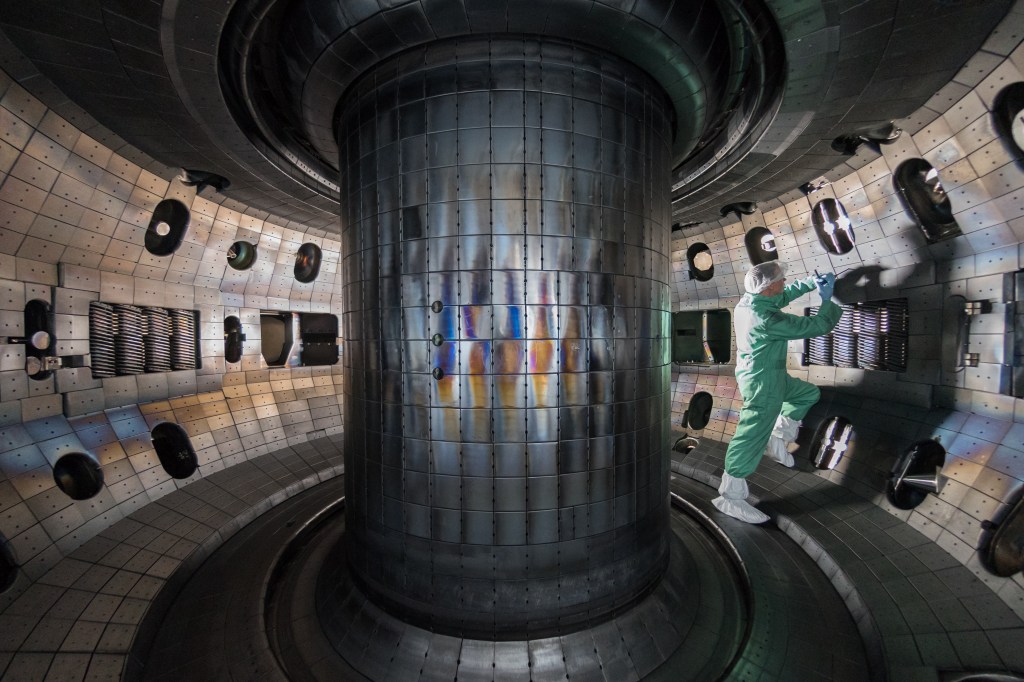
Interior of a Tokamak Fusion Reactor
By Rswilcox – Own work, CC BY-SA 4.0, https://commons.wikimedia.org/w/index.php?curid=73919081

Fusion is one of those technologies that seems more appropriate for Star Trek than serious policy discussions. It seems too futuristic, too science fiction-y. But, it’s a very real technology with some pretty amazing potential. Part of the reason it seems too futuristic is because it always seems to be just over the horizon. Scientists have been working on a fusion reactor for decades, with relatively little progress for us outsiders to see. There’s a tired joke among energy nerds that “fusion is always 30 years away” because scientists seem to have been saying that for decades.

As an outsider who does not work in the industry and cannot appreciate the magnitude of recent technologic advancements, fusion still feels like it’s decades away. That’s an important caveat when reading my analysis, I am not qualified to assess the veracity of claims made about the technology, I can only go on what the experts say. My questions about fusion relate to things like timeframes and costs, rather than technological feasibility. By all indications, we’re marching steadily towards a working fusion reactor sometime in my lifetime. And that’s exciting!

Now, when people talk about fusion, they often use hyperbole. They will say things like “fusion can create near limitless power” which is silly. I think they say this because the fuel comes from sea water, and water is obviously quite abundant. The promise of fusion is that we will be able to get an enormous amount of energy from just a small amount of water. Further, not only is our planet covered in water, but Mars, Europa, and Enceladus all have abundant water reserves. So, we’d be set on fuel for many centuries. But, fuel is not the only limiting factor. We will need to build a fleet of these reactors, and as of right now, we don’t even know what materials we need to do that. Until we know exactly what we need to build these things, we should not assume that the materials will be cheap and abundant.

Assuming, though, that the materials are easy to obtain, we still have unanswered questions. The plants themselves would have a maximum capacity, so the question is, how much energy would a typical fusion plant produce? I have yet to see a good answer for this. The ITER project in southern France is the largest nuclear fusion reactor in human history. It’s been under construction since 2007, costs tens of billions of dollars, and when it finally comes online (supposedly in 2025), it will produce 500 Megawatts of power. That’s not a small amount of power, but it’s still less than a typical fission reactor. ITER is obviously an experimental station, and not meant to compete with commercial energy generation, but with all that money and material, we’re still talking about a fairly small amount of power generation. So the question remains, how much power will we get out of these reactors? That will tell us how many we need to build.

The next question is cost. Of course, as with any new technology, the cost of the initial projects will be astronomical. But, what is the expected cost per watt in say 2040? As an energy nerd, I know predicting energy prices 18 years out is a fool’s errand, but we should at least be reasonably confident that costs will be competitive in an acceptable timeframe. Remember that solar, wind, and energy storage systems are all getting cheaper every year and that’s likely to continue. Eventually fusion will need to compete with them on cost, but it will undoubtedly need a lot of government support to get there. Personally, I have no problem subsidizing fusion since it has enormous upsides. Without government support, the fusion sector would probably wither and die.

Perhaps most important is the timeframe for these things. This is pretty hazy right now. First we need to have a working fusion reactor, which is something we’ve been working on for decades and still don’t have. If it takes a few more decades, then it will be too late for fusion to impact our climate fight. But even if we get a working fusion reactor say in the next 5 years, it would still be decades before fusion reactors were producing power at scale.

Unfortunately, time is not on our side when it comes to climate. Ideally, the electricity sector will be mostly decarbonized by 2035. Fusion may or may not be available at by then, but it almost certainly won’t be at scale in 10 years (if it is, I’ll gladly eat my words since that would be an amazing achievement for our civilization). We need to be focusing on the solutions we have right now, while supporting fusion and other advanced energy technologies. Solar panels use rare Earth minerals and there may be an upper limit to how many we can really install. We never want to put all our faith in a single technology. This isn’t an either/or situation, we can support advanced energy technologies and implement our existing solutions.

So, let’s celebrate the wins on fusion, keep the research money coming and encourage these achievements, but we should not count on a technology that does not yet exist. Until we have a working commercial fusion reactor, we should not rely on it as one of our solutions. A tool isn’t a tool if it’s still being designed. Or, as we say, don’t count your chickens until they hatch.

If you take anything away from this post, it should be this, advanced energy technologies like nuclear fusion are fantastic ideas that are worth our support and we should celebrate their development. However, no single technology will save us, we are in a race against time, greed, and indifference and we’re losing. We must accelerate our existing solutions, we must cap our emissions as soon as possible and begin the long, laborious, and complex process of decarbonizing our civilization. We do not need new technologies to do this, and we should not wait for some innovation to swoop in and save us at the last minute.

Assuming we don’t see any developments on the BBB front, I will next explore green hydrogen and genetic engineering as climate solutions. Have a wonderful weekend and stay safe!

Half a Trillion for the Climate

Yesterday, President Biden announced the new “framework” for his Build Back Better agenda. As we know, his agenda is split into two big bills, one is a so-called ‘bipartisan infrastructure bill’, which focuses on traditional infrastructure like roads, bridges, pipes, transit, and rail projects. This bill totals $1 trillion in spending and when it passed the Senate back in August, it had 19 Republican votes. This was a shockingly high number of GOP votes. The bill, also known as BIP, is still sitting in the House, where progressives have used it for leverage to pass the partisan bill (which I’m going to call BBB from now on).

BBB started off at $6 trillion when it was proposed by Bernie Sanders. This was reduced to $3.5 trillion when it was introduced in the House, and now thanks to Joe Manchin and Kyrsten Sinema, it’s been lowered to $1.75 trillion. On the surface that may look like a huge sacrifice, but this is how things always go. We were never going to pass the Bernie Sanders plan, even if the Democrats had 60 seats in the Senate and 350 in the House, they’d never do something that big. $3.5 trillion, however, has the backing of 48 Democrats in the Senate. In order to get to $1.75T, a number of priorities like paid family leave have evidently been cut completely, while other programs have been shortened or reduced in scale.

That being said, let’s focus on the climate provisions. In total, the BBB has $555 billion for climate provisions, mostly in the form of tax incentives. These incentives are for clean energy like wind, solar, and energy storage, along with incentives to decarbonize industrial sectors like concrete, aluminum, and steel. There are credits for electric vehicles, as well as improving energy efficiency in buildings, and grants for developing new technology.

This framework was specifically designed to win the support of Senator Joe Manchin, who has said publicly that he supports “innovation, not elimination (of fossil fuels)”. Obviously, we aren’t going to innovate our way out of this mess, we need to reduce and eventually eliminate fossil fuels from every sector of the economy, but as long as Manchin is the deciding vote, we simply aren’t going to get that through Congress. The president has to work with what he has, and he’s come out swinging for climate action.

Combined with the energy aspects of the BIP, this would be a big down payment on climate action. It certainly is not sufficient to get us where we need to be, but it would be a huge step in the right direction.

One really important question is whether or not the tax credits are refundable. This is a huge question for equity and equality.

You see, currently tax credits for solar and EVs are not refundable. That means that in order to get the full value of the tax credit, you have to have enough federal “tax liability”. That sounds a little complicated, but it really isn’t.

Let’s look at an example. If you buy a solar system for your home that costs $20,000, you can take the federal tax credit at 26%. .26 x 20,000 = $5,200. However, you don’t get that money from the government, that’s a reduction in the amount of taxes you need to pay. So, if you owe the government at least $5,200 in taxes, you can take the full tax credit. If, however, you only owe $2,000, you can take $2,000 this year and then up to $3,200 next year, as long as you owe that much. Considering that roughly half the US population doesn’t even pay federal taxes, this means that the main solar incentive is unusable for a very large % of the population. Of course, people who don’t pay federal taxes are also less likely to own property, so they can’t take the tax credit anyway since they can’t install a PV system. This is an entirely separate, but equally important issue for a different post.

The bottom line is, under the current system, if you own your home and you pay little to no federal taxes, it’s more expensive for you to buy solar panels that it is for someone with a large tax bill. This means that solar and EVs are largely limited to upper income households. By making the tax credits refundable, we can help alleviate this inequality.

With a refundable tax credit, you always get the full value of the credit. If you owe enough in taxes, you can take the credit the normal way, but if you don’t owe enough in taxes, you simply get the credit as a cash refund. This means that the new tax credits will be accessible to millions of new people, and greatly increase the number of moderate to low income households who can affordably buy solar panels and electric vehicles.

The EV credits are worth $12,500. For economy vehicles, this could make the price of the EV version pretty close to that of the standard version. For example, the Hyundai Kona starts at $21,150 while the EV version lists at $34,000. The Mazda CX 30 starts at $22,500 while the new electric Mazda MX 30 starts at $34,645. The standard Kira Niro starts at $24,690 while the EV version is at $39,990. This is essential if we want EVs to become the norm for most buyers. Most of us aren’t luxury car drivers and we never will be.

Even if this bill passes, there is still an enormous amount of work to be done. The good news is, we know what we need to do, and this massive investment by the federal government would really accelerate things. I won’t celebrate until we’re over the finish line, but I will say that I’m very pleased with the framework that the president has given us. I was very concerned that climate would get cut significantly, but so far the total amount of spending has only been trimmed slightly, even if the programs have been changed.

Tax incentives for popular, high growth sectors seem like they’d be pretty popular, but it remains to be seen if any Republicans will put common sense over partisanship. I’m skeptical, but I’ve been wrong before.

Here Come the Reports

In the lead up to COP26, a number of organizations are releasing climate reports. From places as disparate as the Lancet (a leading medical journal), the Pentagon, and the UN, these reports are tackling the climate problem from various angles. In the coming week, I expect we’ll see a few more released, along with an increase in the typically modest coverage of climate in the media.

Not surprisingly, these reports are bleak. One study showed that the promised “green” recovery from Covid19 was really a boon to fossil fuel production. Another indicated that most fossil fuel-producing countries plan to increase their production in the next decade. The Lancet called climate “the defining narrative of human health”.

These reports are just the climax on a year of very dire and increasingly desperate reports outlining the crisis. In August, the UN Secretary called climate change a “code red for humanity“, and people have started adopting that terminology in subsequent coverage.

Unfortunately, all of these warnings have lead to almost zero action. President Biden’s climate plan is being stifled by one obstinate senator. An energy crisis grips much of the world, and the climate disasters keep coming. These reports only confirm what we already know: things are bad.

It would be very easy for someone like me (and maybe someone like you) to get lost in these reports. We must fight the urge to give up. No matter what happens, no matter how bad things get, we can still try to move forward. Any climate mitigation and adaptation is going to help in the long run, even if we miss all of our targets.

COP26 will be full of a lot of pretty talk, and we may even get a few big commitments, but commitments are meaningless without real action. Under the current level of commitments, we would still warm 2.7o C by the end of the century. And we aren’t even on pace to hit those commitments.

I’ve been feeling rather defeated recently. Joe Manchin’s greed and/or stupidity is just too much to handle. The arguments against climate action are silly, and even though I try to give him the benefit of the doubt, it’s getting harder and harder. I guess it isn’t surprising that a guy whose personal fortune is heavily invested in fossil fuels would stand tall for them.

That’s all for now. Be safe and have a great weekend.

COP26 Primer

We are about 2 weeks from the beginning of the 26th Conference of Parties (COP26) to be held in Glasgow. This is the most important climate conference of the year, it’s been held annually (except for last year) since 1995. This year’s COP is the most important COP since 2015 and represents a rare opportunity to get us on the right path towards a carbon neutral economy.

However, the COP is riddled with potential pitfalls. The system itself has been around for 27 years and done very little to slow down our increase in Greenhouse Gasses (GHG). In fact, carbon emissions have risen sharply since 1995, driven largely by an increase in coal production in China, India, and other “emerging” markets. Meanwhile, most developed countries, especially the United States, have done little reduce their emissions. There has never been a meaningful piece of climate legislation passed by the US Congress.

The high water mark of the COP system came in 2015 at COP21 in Paris. You may have heard of the “Paris Agreement”, well this was a product of COP21. This agreement was the largest and most comprehensive global agreement on climate change in human history. It set a goal of keeping warming under 2o C with a reach goal of 1.5o C.

There are almost zero countries on pace to meet their targets, which require the world to be carbon neutral by 2050 (or more accurately, to be carbon neutral before we burn up all of our remaining carbon budget). At the current pace, we will pass the 2o tipping point by 2030.

As I’ve said before, this conference may be our “last, best chance” to start moving in the right direction. There are a confluence of factors, the looming US elections, the rapidly-approaching deadlines, and the time required to decarbonize that make this a key inflection point.

The thing is, this is not the first “last, best chance” we’ve had. 2015 was a last best chance. There were probably others. However, we may not get another chance to keep warming under 2o. Unfortunately, things aren’t looking very good. The UK government, which is hosting the conference, has already moved the goal posts. President Biden’s big bills (both of which have climate provisions) appear to be floundering in Congress. President Xi Jinping of China just announced he won’t even be attending the conference.

There is still time to turn things around. If the Democrats can pass their bills with the climate provisions mostly in tact, then it will change the tone of the conference dramatically. If President Xi is not present, it opens the door for President Biden to take center stage. However, without a big win at home, it’s doubtful he’ll have much influence.

I expect the next few weeks will see an increase in the typically modest coverage of climate change. Only time will tell what happens at COP26. In the end, agreements and commitments mean nothing without implementation. As they say, talk is cheap.

I’ll follow the COP26 negotiations as closely as I can. We still have the two big bills working through Congress, and even if we get everything we want, we’ll need to turn our attention to the states, where more action is needed.

Thanks for reading and have a great weekend!

On Nuclear Fusion

This year there have been some major announcements regarding nuclear fusion. From the Lawrence Livermore Laboratory to a company based down the road from me in Cambridge, MA called Commonwealth Fusion Systems (CFS) it seems like we’re on the verge of some major advancements in this futuristic technology. The CEO of CFS is just the latest person to argue that fusion is an “essential” component of decarbonizing our world. I am in no way qualified to evaluate the technology being used here, or if the timelines presented by the various fusion backers are realistic, however even if they are correct (this is a big if), then that really doesn’t change the fundamental truth, that fusion probably won’t play a major role in decarbonizing our economy.

Let’s look at why. First, according to the timelines presented by the backers, we may have a working fusion reactor by 2025 and a commercial reactor by 2030. These targets seem pretty ambitious to me, considering we’ve been “10 years from fusion” since the 1960s, but for the sake of argument, let’s assume they are correct.

A working commercial fusion reactor would be an amazing achievement. It isn’t hard to imagine a future where fusion plays an important role in powering our society. Maybe fusion reactors will power our starships, or help us suck carbon out of the atmosphere.

But, they are unlikely to play a major role in decarbonizing our economy. If we have our first commercial fusion reactor by 2030, then that means we have managed to clear all the regulatory hurdles in at least one jurisdiction. But, that doesn’t mean every jurisdiction will automatically accept it. Creating regulations for a brand new type of power plant, particularly one with the word “nuclear” in it, would be challenging. Under normal circumstances, it would take years to get these regulations approved, and in the United States, much of this regulation is done by individual states. So we’re talking about potentially hundreds of individual jurisdictions who have to give their approval, and then each individual power plant has to win approval, potentially over the objections of local opposition. Siting new power plants is slow, combative, and bureaucratic.

Further, it takes years to build a new power plant. So if the first commercial plant is operational in 2030, how many others will be built that same year? One? Ten? How much power will these plants produce and at what cost? We have no idea what these costs would be, and it seems unlikely that the first iteration of a nuclear fusion plant would be the cheapest, and even if fusion is a wonderful technology, if it can’t compete with renewables on price, it isn’t going to get built (without subsidies).

That being said, even if we are able to build cheap, abundant nuclear fusion plants by the 2030s, and they are quickly approved by every major jurisdiction, we still have other problems.

Of the major sectors that require decarbonizing, the electrical grid is the easiest. Followed by light transportation and mass transit, and then building heat. Industry, heavy transportation, and agriculture are likely the hardest sectors to decarbonize. This is why the Biden climate plan focuses on decarbonizing the electricity, light transportation and building heat sectors between now and 2030, with research and development aimed at the other sectors in anticipation of decarbonization between 2030 and 2050.

Fusion reactors don’t create usable energy on their own. They create an enormous amount of heat that is used to boil water, which creates steam that is used to turn a turbine that generates electricity (all fossil fuel power plants follow the same principle).

As you can see, the timelines just don’t add up. If we decarbonize the electricity sector by 2030 or 2035, there won’t be much need for nuclear fusion. And if wind, solar, and storage have all become even cheaper than today, then fusion may not even compete on price and reliability.

Waiting for fusion reactors to become available before decarbonizing would be a disaster. At the current rate of emissions, we will use up our carbon budget in 10 years. If we wait that long to decarbonize, we will lock in 2 or 3 degrees C warming. 2 degrees would be extremely difficult, 3 degrees would be catastrophic.

However, in case you think I’m against fusion, let me be clear that I’m very much in favor of it. It’s an amazing technology that could play an important role in making our society truly sustainable. It’s possible (and perhaps likely) that there are ways fusion could help decarbonize our economy that I haven’t even thought of. And, having cheap, abundant, reliable, and pollution-free energy at our disposal is an unambiguously good development.

But, the danger is complacency. We cannot wait for some miraculous technology to save us. This isn’t an Ancient Greek play where the gods are going to swoop in at the last moment. We still don’t know if commercial fusion reactors are even viable, and we certainly don’t know if they will be available by 2030. We have solutions in hand that can help us cap and reduce our emissions immediately, and we need to implement them. Even if wind and solar are eventually supplanted by fusion reactors sometime in the future, we need to cut our emissions right away.

These advancements in fusion technology should be celebrated. These companies and labs should be funded, and we should encourage people to study the sciences and develop these and other sustainable technologies. But, we cannot put our faith in techno-wizardry with no guarantees of success. We simply don’t have time to wait for a miracle, especially when we can get moving in the right direction with the solutions we already have.

Climate Solutions Friday – Solar Electricity

This week the Biden Administration released a roadmap to expand our solar energy capacity dramatically over the next 2 decades. The report is titled “The Solar Futures Study” and was created by the National Renewable Energy Lap (NREL) at the Department of Energy (DOE). The Biden Admin claims that solar, which currently supplies 4% of our electricity needs, could meet 45% of our needs by 2050. To get there, we would need a significant expansion in the amount of solar we install each year.

2020 was already a record year for solar installations, when 15 gigawatts of solar capacity were added to the grid. For reference, one average single family house needs roughly 10 kilowatts of capacity to meet their needs, so 15 gigawatts is approximately enough for 1.5 million homes. To get to 45% by 2050, we would need to double our annual installations every year from now until 2025 and then double them again, to 60 GW per year after that.

There are a huge number of challenges in doing this. First, it’s not so easy to double the amount of solar capacity installed in just one year. We need massive investments in supply chains, in worker training, and incentives. A great deal of this will have to be done by utilities, many of whom may resist adding so much solar to their generation assets. And, in order to hit this target without totally destabilizing the grid, we will need unprecedented investments in energy storage, as well as in transmission lines, both of which come with their own problems.

That’s not to say that we can’t do it. I am very pleased with the Biden Admin’s goals here. But we should be realistic about what it will take to get there.

Part of the administration’s plan involves something called a clean energy payment plan, this would be a subsidy for utilities to switch to renewables. Many utilities are slow to adopt changes, even if they are making big commitments on climate. The best way to get them there without a mandate (which can’t happen without Republican support) is with financial incentives.

Solar is, in many jurisdictions, the cheapest form of electricity. In some instances, it’s actually cheaper to build a solar facility than it is to keep running an old coal-fired power plant. However, while fossil fuel plants can be concentrated in specific locations (something that causes no shortage of environmental justice issues), solar facilities have to be spread out in much larger areas. Solar can also be put on houses, businesses, over parking lots or parking decks, or even above roads. The grid was designed for large, centralized power plants, not distributed energy resources like solar. And, the best solar resources are often far from population centers. This means that we need colossal investments in the electrical grid, including the construction of large (unsightly) transmission lines. These are all significant challenges that a require funding, as well as advocacy (who wants power lines running through their neighborhood?).

The challenge to make this happen is enormous, but the potential rewards are even greater. In addition to lower carbon emissions, we would drastically cut all sorts of air pollution, including sulfur dioxide, smog, particulate matter, aerosols, and mercury. Cleaner air means healthier lungs.

The Biden plan is good and if we can implement it, we will begin the heavy work of moving ourselves away from the climate-altering experiment we’ve been performing for the past century.

However, as I’ve said, securing the funding is only the first step.

Climate Solutions Friday – Sept 3

I’m going to be frank, the past 2 weeks have been pretty awful. Between the chaotic and tragic scenes in Afghanistan, the terrible Supreme Court abortion ruling, the rise of people using horse de-wormer instead of an FDA approved vaccine, and the powerful, deadly hurricane I’m feeling more than a bit overwhelmed. So many people are more personally and acutely effected than me. I’m not an Afghanistan veteran or part of a Gold Star family, I don’t personally know anyone who has died of Covid-19, I wasn’t hit hard by the hurricane, and I don’t have a uterus. I recognize that all of these things are essentially priviledges for me. Still, watching these mostly preventable things happen in real time is hard to watch. Knowing that I have it easier than other people gives me no comfort.

I think it’s important to understand the role that politicians have played in all of these events. Warmongering politicians got us into Afghanistan in the first place. Anti-woman politicians passed the Texas abortion law and appointed the anti-woman justices. Anti-vaccine politicians are promoting the horse de-wormer. And climate denying politicians have prevented us from doing anything about climate.

Even this week, Senator Joe Manchin published an infuriating op-ed in the Wall Street Journal, a fitting place for such a piece, stating that Democrats should hit the pause button on their $3.5T spending package. This package includes President Biden’s two signature climate policies: the clean energy payment plan, and the extension of the clean energy tax credits. Even these two market-based schemes will probably be inadequate, but it’s the best he could do under the Senate’s crazy, anti-democratic structure.

And now Manchin’s op-ed has put us on our heels at the last minute. Is he bluffing? Is he just trying to appear “fiscally conservative”? In Manchin’s defense, he has a tendency to make big, bold proclamations challenging Democratic leadership only to vote along with his party when the time comes. Maybe that’s why his Senate colleagues aren’t ringing alarm bells.

If he and the other so-called moderates need to extract their pound of flesh, then so be it. But there’s a limit.

I apologize for sounding so negative in a climate solutions post. As I said, I’m feeling a little overwhelmed.

The most important thing we can do for the climate is elect leaders who will take the issue seriously. In a perfect world, Democrats, Republicans and third parties would all work together on this issue. We’d be arguing about how to fight it, not whether or not we should.

If you’re a Republican or know a Republican, encourage them to vote in primaries. Vote for candidates who acknowledge climate change and want to do something about it. If you’re a Democrat, do the same in Democratic primaries. But more importantly, vote in as many primaries and elections as you’re legally allowed. Every level of government has a roll to play, and lower level elections, like the recall in California or the state elections in Virginia that are both coming up soon, tend to have very low turnout. Cities and state legislatures have the ability to make great progress on these issues, but the most reliable voters tend to be older and more conservative.

Climate change is fundamentally a political problem. We don’t need some magic technology, we have solutions already. We need to implement them as soon and as widely as possible. Every president since LBJ has known about climate change and every president since LBJ has failed miserably to address it. Some presidents, notably Ronald Reagan and Donald Trump, actively worked to make things worse.

We’re running out of time to get this right. Vote, march, organize, run for office, do something to get the needle moving. Politicians who deny climate action must be punished at the ballot box. Systems that unfairly allow those politicians to stay in power must be altered.

Update on the Climate Bills

Last week, Senate Majority Leader Chuck Schumer (D-NY) announced that combined, Biden’s two bills would cut emissions 45% by 2030. This, he said, together with the actions on the state level by a cadre of high-income, left-leaning states (CA, HI, MA, MD, NY, NJ, among others), would get the US to Biden’s goal of cutting emissions 50% (compared to 2005) by 2030.

Sounds great, right? After all, scientists say we need to cut our emissions at least 50% by 2030 in order to be on pace for carbon neutrality by 2050. (If you’re wondering why it will take 20 years to go from 50% to 100% but only 9 years for the first 50%, not all sectors of the economy are equally difficult to decarbonize. Transportation and electricity are the biggest and easiest, and that’s where Biden’s bill puts most of its climate focus. Industry, heating, and agriculture will be harder and will take more time).

However, there are a lot of caveats here. First, the final version of the bill hasn’t been announced, Schumer says it will be announced by Sept 15. Until then, we are just guessing at what it contains, we have some topline numbers, but no details. The centerpieces of the reconciliation package are the clean energy payments program and the extension of the clean energy tax credits.

Second, this bill is almost certainly going to get cut. The topline number is $3.5 trillion, and a coalition of conservative Democrats, especially Joe Manchin and Kyrsten Sinema, will demand that the total amount be reduced. This will be of critical importance. How much will be cut and from which programs? The bulk of the spending is for social programs, so will they bear the brunt of the cuts? Or will climate be sacrificed because it isn’t the main focus of the bill?

We’ll need to keep an eye on both of these things. But, assuming it is actually passed (another question mark) and assuming the climate portions remain relatively unscathed, then what? Do we just sit back and celebrate?

If both of these proposals are passed, then I will celebrate for a day. However, the work is far from over. Immediately following the success or failure of these packages the COP26 summit will commence in Glasgow. Almost every nation in the world has failed to live up to its Paris Agreement commitments, and the Paris Agreement wasn’t sufficient in the first place. Time is running out to craft an effective international treaty that will cap emissions as soon as possible. The United States is fully back on board for the first time since 2015 (technically the 2016 conference happened during the Obama Admin, but he was a lame duck and Trump was elected while the conference was happening).

As I’ve said before, this is probably the last best chance for the US to do something big (and positive) on climate. It’s very unlikely that the Dems will hold both houses of Congress next year, and even if we capture both houses and keep the White House in 2024, it may be too little too late.

What happens, then, if everything goes right? Assuming we pass both bills and we get a strong COP commitment, then what do we do? If Schumer’s office is right, then the US will be on pace to meet its agreements domestically. But here’s the thing about projections for very large, very complex economic transitions, they’re very hard to get right. Projections for climate-related trends are almost always incorrect (for instance, renewable energy has gotten cheaper faster than expected, and extreme weather has happened faster than expected). So we must remain vigilant. Ideally we would cap global emissions in the next couple of years, and begin our steep decreases as soon as possible.

That means we will need to monitor our progress. It also means the US and other rich countries will need to send resources to developing countries, something they have largely failed to do so far. Domestically, here in the US we will need to shift our work back to state and local-level action. There is a lot of room for improvement in states. In blue states, where leaders have made big commitments, we must ensure they keep their promises. In swing states or red states, we must find ways to lower emissions without talking too much about climate. People of all political stripes care about saving money, breathing clean air, getting independence from your utility, or growing your local economy.

Cities can play a huge role by updating their building codes. This is a longer-term strategy, but we have 30 years to get everything right, and if we start now we can make some serious improvements. Cities can also invest in things like pedestrian and bike infrastructure, transit, and green space. Cities can build flood barriers and flood plans, and they can decarbonize their own buildings and fleets. Cities can change zoning laws to encourage density and walkability. All of these are tangential to climate, but would have positive climate benefits.

For now, though, the focus must remain on getting these bills passed with as few cuts as possible. To put it bluntly, nothing will really matter if we can’t get this done. Failure to do so will be catastrophic.

News Roundup – August 16

Europe Sets Heat Record – The temperature in Floridia, Sicily hit 124 degrees, the highest ever recorded in Europe. That means the highest temperatures ever recorded in Europe and North America happened barely a month apart. Unfortunately, I doubt either record will last very long.

Study says “blue hydrogen” may be worse than Natural Gas – Many people believe hydrogen will be an essential zero-carbon fuel. There are a few ways of producing hydrogen, the most common is called “gray” hydrogen and it involves using natural gas. Blue hydrogen was supposed to be better for the environment, but a new study concludes it might be worse than just using natural gas directly. That leaves only “green” hydrogen as a viable path. Green hydrogen involves using renewable energy to power electrolysis machines that separate water into hydrogen and oxygen. In order for this to make financial sense, the cost of renewable energy and electrolysis must come down significantly.

Attribution Science Powers IPCC Report – Between the last IPCC report in 2014 and today, something called attribution science has gotten much more sophisticated. This new knowledge allows us to attribute individual weather events to climate change. For many years, we simply could not attribute weather events with a changing climate, making it very hard to convince people. Some bad faith commentators would often point out (correctly) that we could not blame climate change or a certain hurricane or fire, and then they’d argue that we shouldn’t worry about climate because of this. That was a stupid argument then, but it makes less sense now. Since we can actually make that attribution. This is one of several new scientific tools developed over the past year that have removed any lingering doubts about our role in a changing climate.

News Roundup – Aug 9

The news this week is pretty bleak. There is no positives spin to put on this, we just need to turn things around and prepare for what’s to come.

Biden Sets Electric Vehicle Goal – President Biden announced a plan for EV’s to comprise at least 50% of new US auto sales by 2030. As of this year, EV’s make up barely 2% of all new vehicle sales. Biden’s announcement coincided with a number of major car dealers announcing plans to be fully electric between now and 2050.

Important Atlantic Currents on Verge of Collapse – The Atlantic Meridional Overturning Circulation (AMOC) are a collection of ocean currents that transport warm water from the Tropics to the North Atlantic. This system is what keeps Europe warm (New York City is roughly the same latitude as Madrid, Spain) and also transfers heat away from the Tropics. A new study shows that this system is the weakest it has been in over 1,000 years and that a full collapse could happen at any time. The timeframe for such a system is pretty long and “any time” could mean sometime after 2100, but that’s not guaranteed. If we keep emitting greenhouse gases, the system will eventually collapse with catastrophic consequences for the weather.

New IPCC Report Warns of Dire Consequences – The first installment of the Intergovernmental Panel on Climate Change’s Sixth Assessment Report was released today, and the news is dire. The IPCC science assessment removes any doubt that humans are causing climate change, stating that some of this summers heat waves have a “near zero” probability of happening without human-induced climate change. It warns that the heat waves and other extreme weather seen this summer are only the beginning. It estimates that the climate would stabilize 20-30 years after we stop emitting emissions, that means that if we reach net zero in 2050, the climate wouldn’t stabilize until roughly my 90th birthday. Stabilize in this context does not mean “return to the climate of 1950” it means thing would stop getting worse, but we’d still have an additional 50-60 years of damage, on top of the damage we’ve already done.