
If you get news alerts for climate or energy, you may have seen a flurry of recent announcements regarding nuclear fusion. Scientists in Europe and North America have made breakthroughs in recent weeks, using different techniques, in the quest for a stable, energy positive nuclear fusion reactor. These developments are tantalizing and exciting, but we should also keep things in perspective. Let’s be clear, commercial nuclear fusion reactors are still years away and given the time constraints, they may not have a serious impact on our climate goals. So, while these developments around fusion are unambiguously positive achievements, we should not count on fusion to save us.
As I’ve said before, we must focus on reducing emissions now. The danger with fusion is that we drag our feet on emissions reduction because we think this miracle tech is going to solve our problems, like some modern “deus ex machina.” That’s a recipe for disaster. At the same time, we should all want nuclear fusion to work. It’s truly a revolutionary innovation with the potential to address a number of problems, including climate change. So, my point is not to disparage these recent developments, I think we should be celebrating them, but the hype machine is running at full capacity and we’re in danger of losing our perspective.
First, let’s start with some basics. There are two kinds of nuclear energy production: fission and fusion. Fission involves splitting a heavy atom like uranium, which releases a large amount of energy. Fusion involves smashing together two light atoms, typically two hydrogen atoms, to form a heavier atom, in this case helium. Every nuclear plant on Earth uses fission, however, fusion is the thing that powers the Sun (and every other star as far as I know).
I’ve written before that nuclear fission is a perfectly viable zero-carbon power source and has some advantages over other power sources. But, it also has a number of challenges, namely perceived safety risk, price, and radioactive waste.
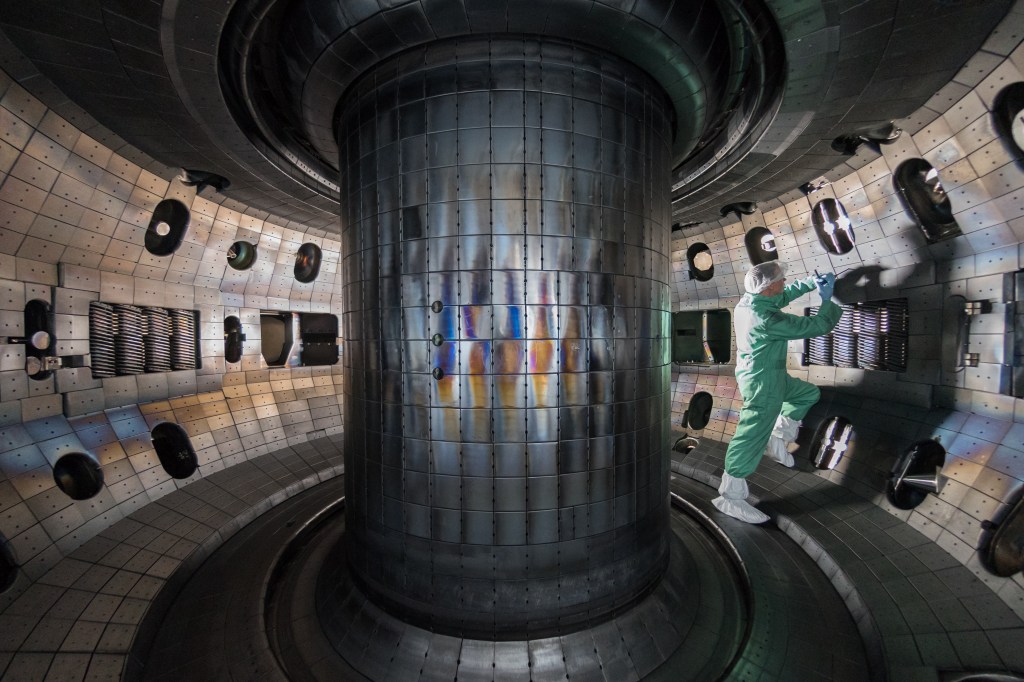
By Rswilcox – Own work, CC BY-SA 4.0, https://commons.wikimedia.org/w/index.php?curid=73919081
Fusion is one of those technologies that seems more appropriate for Star Trek than serious policy discussions. It seems too futuristic, too science fiction-y. But, it’s a very real technology with some pretty amazing potential. Part of the reason it seems too futuristic is because it always seems to be just over the horizon. Scientists have been working on a fusion reactor for decades, with relatively little progress for us outsiders to see. There’s a tired joke among energy nerds that “fusion is always 30 years away” because scientists seem to have been saying that for decades.
As an outsider who does not work in the industry and cannot appreciate the magnitude of recent technologic advancements, fusion still feels like it’s decades away. That’s an important caveat when reading my analysis, I am not qualified to assess the veracity of claims made about the technology, I can only go on what the experts say. My questions about fusion relate to things like timeframes and costs, rather than technological feasibility. By all indications, we’re marching steadily towards a working fusion reactor sometime in my lifetime. And that’s exciting!
Now, when people talk about fusion, they often use hyperbole. They will say things like “fusion can create near limitless power” which is silly. I think they say this because the fuel comes from sea water, and water is obviously quite abundant. The promise of fusion is that we will be able to get an enormous amount of energy from just a small amount of water. Further, not only is our planet covered in water, but Mars, Europa, and Enceladus all have abundant water reserves. So, we’d be set on fuel for many centuries. But, fuel is not the only limiting factor. We will need to build a fleet of these reactors, and as of right now, we don’t even know what materials we need to do that. Until we know exactly what we need to build these things, we should not assume that the materials will be cheap and abundant.
Assuming, though, that the materials are easy to obtain, we still have unanswered questions. The plants themselves would have a maximum capacity, so the question is, how much energy would a typical fusion plant produce? I have yet to see a good answer for this. The ITER project in southern France is the largest nuclear fusion reactor in human history. It’s been under construction since 2007, costs tens of billions of dollars, and when it finally comes online (supposedly in 2025), it will produce 500 Megawatts of power. That’s not a small amount of power, but it’s still less than a typical fission reactor. ITER is obviously an experimental station, and not meant to compete with commercial energy generation, but with all that money and material, we’re still talking about a fairly small amount of power generation. So the question remains, how much power will we get out of these reactors? That will tell us how many we need to build.
The next question is cost. Of course, as with any new technology, the cost of the initial projects will be astronomical. But, what is the expected cost per watt in say 2040? As an energy nerd, I know predicting energy prices 18 years out is a fool’s errand, but we should at least be reasonably confident that costs will be competitive in an acceptable timeframe. Remember that solar, wind, and energy storage systems are all getting cheaper every year and that’s likely to continue. Eventually fusion will need to compete with them on cost, but it will undoubtedly need a lot of government support to get there. Personally, I have no problem subsidizing fusion since it has enormous upsides. Without government support, the fusion sector would probably wither and die.
Perhaps most important is the timeframe for these things. This is pretty hazy right now. First we need to have a working fusion reactor, which is something we’ve been working on for decades and still don’t have. If it takes a few more decades, then it will be too late for fusion to impact our climate fight. But even if we get a working fusion reactor say in the next 5 years, it would still be decades before fusion reactors were producing power at scale.
Unfortunately, time is not on our side when it comes to climate. Ideally, the electricity sector will be mostly decarbonized by 2035. Fusion may or may not be available at by then, but it almost certainly won’t be at scale in 10 years (if it is, I’ll gladly eat my words since that would be an amazing achievement for our civilization). We need to be focusing on the solutions we have right now, while supporting fusion and other advanced energy technologies. Solar panels use rare Earth minerals and there may be an upper limit to how many we can really install. We never want to put all our faith in a single technology. This isn’t an either/or situation, we can support advanced energy technologies and implement our existing solutions.
So, let’s celebrate the wins on fusion, keep the research money coming and encourage these achievements, but we should not count on a technology that does not yet exist. Until we have a working commercial fusion reactor, we should not rely on it as one of our solutions. A tool isn’t a tool if it’s still being designed. Or, as we say, don’t count your chickens until they hatch.
If you take anything away from this post, it should be this, advanced energy technologies like nuclear fusion are fantastic ideas that are worth our support and we should celebrate their development. However, no single technology will save us, we are in a race against time, greed, and indifference and we’re losing. We must accelerate our existing solutions, we must cap our emissions as soon as possible and begin the long, laborious, and complex process of decarbonizing our civilization. We do not need new technologies to do this, and we should not wait for some innovation to swoop in and save us at the last minute.
Assuming we don’t see any developments on the BBB front, I will next explore green hydrogen and genetic engineering as climate solutions. Have a wonderful weekend and stay safe!

 The Mangrove