
Today I’m starting a series on several emerging “miracle” technologies, all of which have the potential to radically improve our chances of avoiding a climate crisis, but none of which are currently available at scale. The first technology I would like to explore is called Direct Air Capture (DAC) of CO2. The very first “climate Friday” Facebook post I ever wrote was about carbon sequestration. DAC is a subset of that group, along with “carbon capture” and ecological restoration. Technically, DAC is a subset of a subset of carbon sequestration called carbon removal.
I’ve written before that there are no silver bullets, and I stand by that. No single technology or policy alone will save us, it’s going to take a whole suite of political and technological advancements to get us over the finish line. That being said, there are several technologies with some pretty powerful potential. Any of the tech that I’m going to explore over the next few weeks, could make it much easier to reach our carbon goals. I have not yet finalized my list, but I will be exploring green hydrogen, nuclear fusion, and DAC.
As I’ve written before, carbon sequestration is an essential part of a carbon negative economy, which is what we need as soon as we can get it. There are a few options for this, the first is habitat restoration, which revitalizes natural carbon sinks like grasslands and forests, the second is something called carbon capture, which uses technologies at the end of smoke stacks to prevent the carbon from reaching the atmosphere. Carbon removal, including DAC is a third option that involves machines which pull the carbon directly from the air and stores it, ideally in some useful form like a brick or other material.
The first two approaches are further along. We’ve been altering habitats for thousands of years at this point. But, in order to have an impact on climate change, we have to increase the worldwide capacity of natural carbon sinks. This means that for every carbon sink we destroy, we must restore an even larger carbon sink in order to increase our natural sequestration. However, this has a limit, we obviously can’t restore every forest on Earth (we need land for farms and cities and other uses), and even if we did, this isn’t a permanent solution. You see, natural carbon sinks have a limit to how much they can sequester. Once a tree reaches mature age, for instance, it stops growing (or slows down) and once it stops growing, it basically stops sequestering carbon at a meaningful rate. The carbon is has stored in its trunk and roots remains as long as the tree is alive, but it only sequesters more carbon as it’s growing. So, while a mature forest has a lot of stored carbon, it isn’t really sequestering much anymore since it isn’t doing a lot of growing.
Carbon capture is another technology, one which is often touted by fossil fuel companies because it seems like we can have our cake and eat it too. If we can sequester carbon directly from power plants, then why can’t we keep burning fossil fuels? Well, these technologies don’t trap all of the carbon, or even most of it. Maybe we can improve them, but that would likely drive up the cost of fossil fuels, making them less competitive compared to renewables which have a falling cost curve. I think we all want to fight climate at the lowest cost possible. We should not intentionally make the energy transition more expensive than it needs to be. So, while carbon capture is useful at the moment, it probably won’t make sense in the coming decades.
Direct Air Capture is something different entirely. The machines come in different forms, some look like a stack of box fans, others look a forest of petrified trees.

They suck air in, remove the carbon, and then push the air out. They offer a tantalizing solution to a serious problem. After all, wouldn’t it be easier to just build a huge fleet of these instead of transitioning the whole economy over to new fuel sources? Maybe. But, time is not on our side.
You see, if it were 1950, we might have enough time to implement this solution at scale, but we have about 11 years left in our carbon budget, and scaling up an industry like this will take time. Over the course of a year, the entire DAC industry removes about 8 seconds worth of carbon emissions. Even if that doubles every year for 11 years, a blazing rate of growth, you’re talking about a few hours worth of emissions. Even if I’m off by an order of magnitude in terms of growth, it still isn’t going to be enough if we don’t reduce our emissions. And, if these machines give us a false sense of security we may end up increasing our fossil fuel use and erasing any gains made by DAC.
But, that doesn’t mean this isn’t worth doing. We don’t really need DAC to make a huge difference right now. Our primary focus should be on reducing emissions through electrification and renewable energy + nuclear power. DAC has about 30 years to grow to scale, because in the second half of this century, we will need to begin drawing carbon out of the atmosphere in enormous quantities. As I’ve written before, our goal is carbon neutrality by 2050 and then carbon negativity thereafter, until we reach a global CO2 PPM that scientists deem desirable (probably somewhere between 280 and 350 PPM).
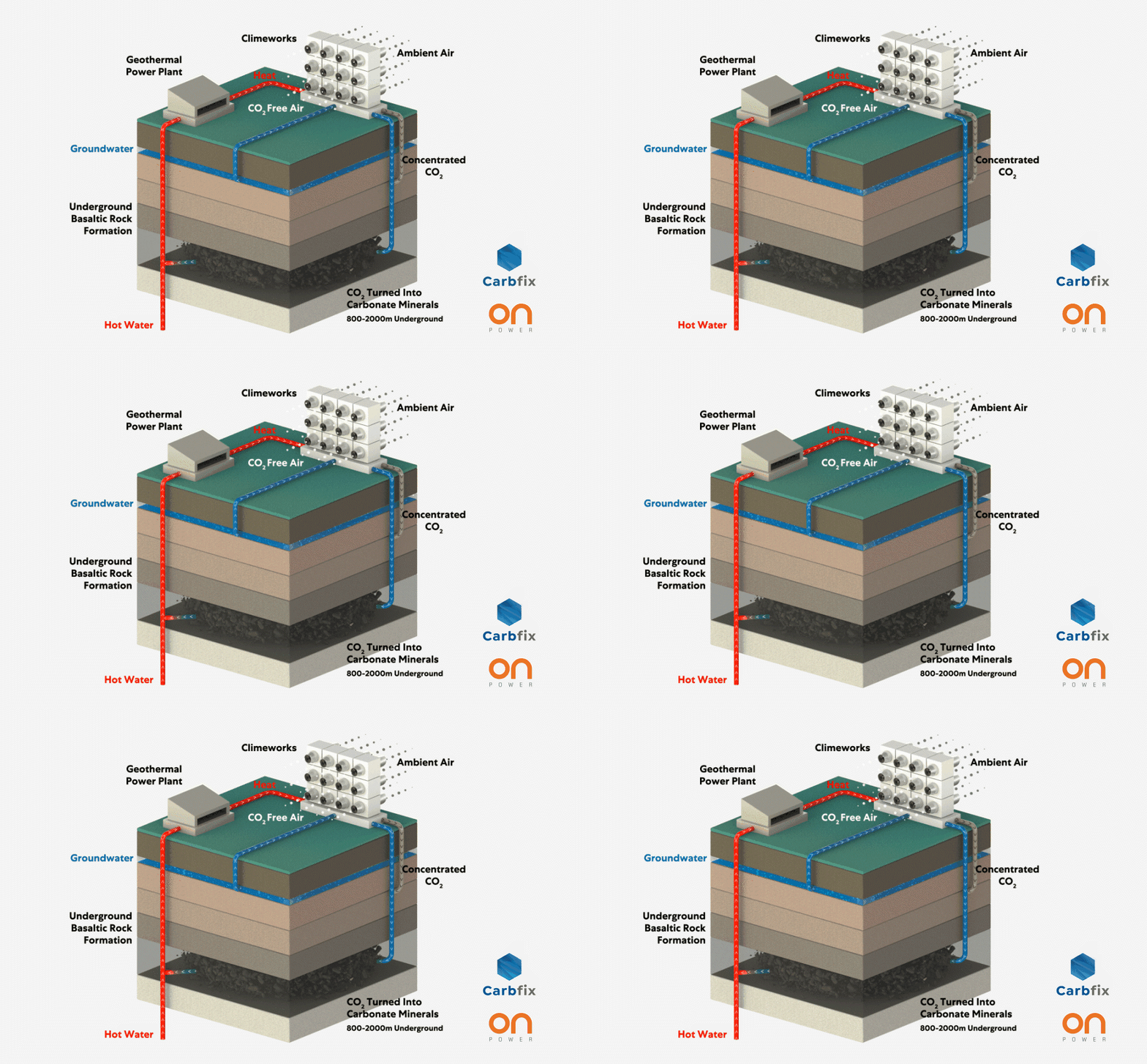
It seems very unlikely that we will decarbonize every aspect of our economy over the next 30 years, so we will need some form of sequestration to fill in the gaps, and direct air capture is the only technology that promises perpetual carbon removal. Carbon capture will shrink as we phase out fossil fuels, and as long as the human population keeps growing, there will be a serious limit on how much ecosystem restoration we can do.
So, ideally, when 2050 rolls around, we will already have a fleet of these plants removing carbon cheaply and efficiently. That should be the focus of government policy in this area. We need public and private investment to improve the technology, to scale production, and to make it affordable.
In order to do this, we need either a price on carbon or a carbon tax, something that will create a market and demand for this service. Right now, the only reason anyone does it is because it’s good for the environment (and a company’s reputation), at least in the US. We need the government to either mandate that companies are carbon neutral, or for the government to tax the carbon in such a way that it’s more affordable to pay for direct air capture than to pay the tax. Without this, the industry simply won’t scale up. Companies and organizations will not voluntarily offset their emission in sufficient quantifies. We can use markets to make this happen, but we need the government to create the market in the first place. A so-called free market will do what it always does, pushes costs and pollution on to the general population wherever and whenever it can. But, a property designed carbon market, which an adequately high price on carbon, will likely be more efficient than a government mandate.
And remember, this is not an excuse to keep burning fossil fuels. This is not a miracle technology that will let us burn coal without consequences. We need both decarbonization and carbon removal. Direct Air Capture has the potential to be an extremely useful tool, and in fact it may be necessary at this point if we want to avoid a catastrophe, but it is not a replacement for clean energy. It is a complimentary technology.
As I’ve said before, the first and most important goal is to reduce and replace our reliance on fossil fuels wherever we can. Some industries, like heavy manufacturing, shipping, and commercial air travel will be very hard to decarbonize, and it may be necessary that we use some carbon removal to make them carbon neutral. But, in other areas like personal vehicles, building heat, electricity, and mass transit, we already have sufficient technologies to decarbonize these sectors. We do not need need to keep coal plants open, or internal combustion engines humming.
Fortunately, the Biden Administration is working to advance these technologies. The DOE announced in June of 2021 6 grants, 3 of which went to companies in my once and future home of North Carolina, that are working on carbon removal, including the mildly creepy project at Arizona State.
Ultimately, I feel quite optimistic about DAC. It is both a very clever and necessary invention. As with most climate issues, the fundamental challenges are time and politics, not resources or technology. With enough support, this industry can scale immensely and have a dramatic impact on our fight against climate change. But, without adequate support, it will remain a curiosity with lots of potential and little actual contribution.
As with all emerging climate technologies, DAC is not a miracle, it is the product of hard work and engineering, and it can’t solve the issue on its own. But, it can be an important tool in our toolbelt, something that can fill the gaps that renewables, alternative fuels, and other innovations can’t solve.

 The Mangrove